
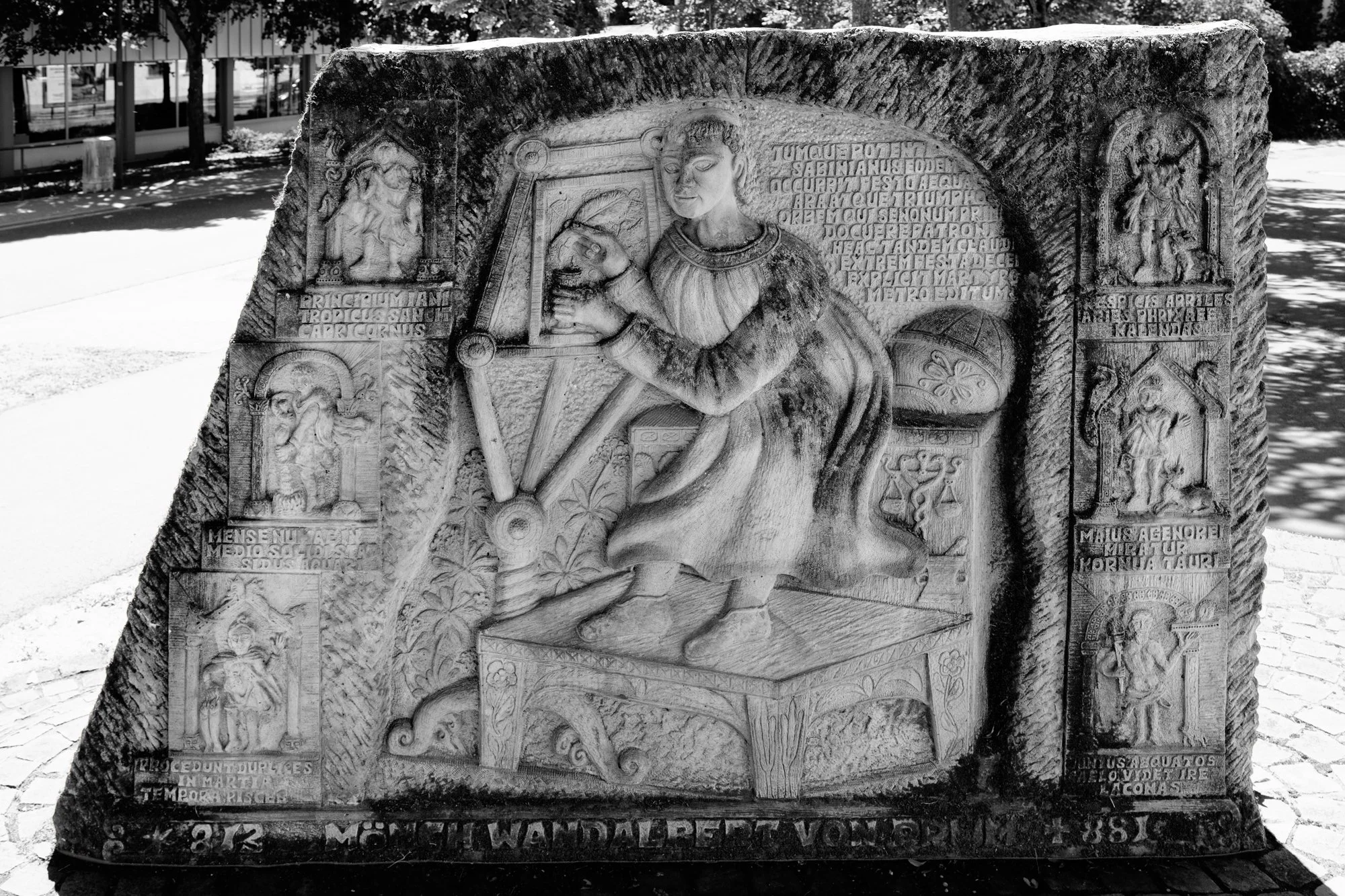
Mönch Wandalbert von Prüm (813).
On a sunlit corner in Prüm stands a block of carved memory. At its center a monk leans over a panel, stylus poised, as if he has just paused mid-line to catch the right cadence. Around him, little reliefs crowd the stone: saints in niches, vines curling like marginalia, symbols for the turning year. This monument —“Mönch Wandalbert von Prüm (813)”— carved by the Eifel sculptor Pit Weiland as part of the town’s Karolingerweg. The Latin beside the figure ends with a scribe’s flourish—explicit martyrium, metro editum… extremum festum Decembris—the tidy full stop of a poet who measures time in verse.
Why Prüm mattered
Prüm was not a remote cloister but a royal powerhouse in the Carolingian world. Kings endowed it with estates, immunity, and the freedom to manage its lands; emperors retired there; pilgrims came for the famed Sandals of Christ. In a region strung between the Moselle, the Ardennes, and the Rhine, the abbey sat on trade routes and supervised a web of farms, mills, and forests that made it an economic hub as well as a spiritual one.
Ecclesiastically, Prüm stood within the province of Trier—the great archbishopric of the Middle Rhine—yet enjoyed the sort of royal and papal protection that gave leading monasteries a measure of exemption from ordinary diocesan interference. Bishops still ordained, blessed altars, and oversaw parish life; but Prüm governed its own house, appointed its officials, and managed a chain of dependent churches and granges on its estates. In the loose but legible hierarchy of the age, the abbey answered upward to throne and pope, coordinated sideways with peer houses across the Carolingian realm (think Fulda, Corbie, Reims), and negotiated locally with the bishops whose dioceses held its lands. That three-level relationship—imperial, monastic, diocesan—explains why Prüm’s voice carried so far.
Its scriptorium and school turned that authority into culture. Charters standardized obligations; cartularies and the later Prüm polyptych mapped holdings like a textual atlas; and scholars such as Regino of Prüm wrote histories that stitched the region into the wider story of Europe.
A poet of the calendar
Wandalbert belonged to this world of rule and rhythm. His metrical martyrology gives every day its saints and begins each month with a poem on the season—weather and winds, vineyard tasks and fish runs, bread and bees and blessings. Read straight through, the book becomes a choreography for a Christian year lived in farms and forests. It is literature, liturgy, and local knowledge at once.
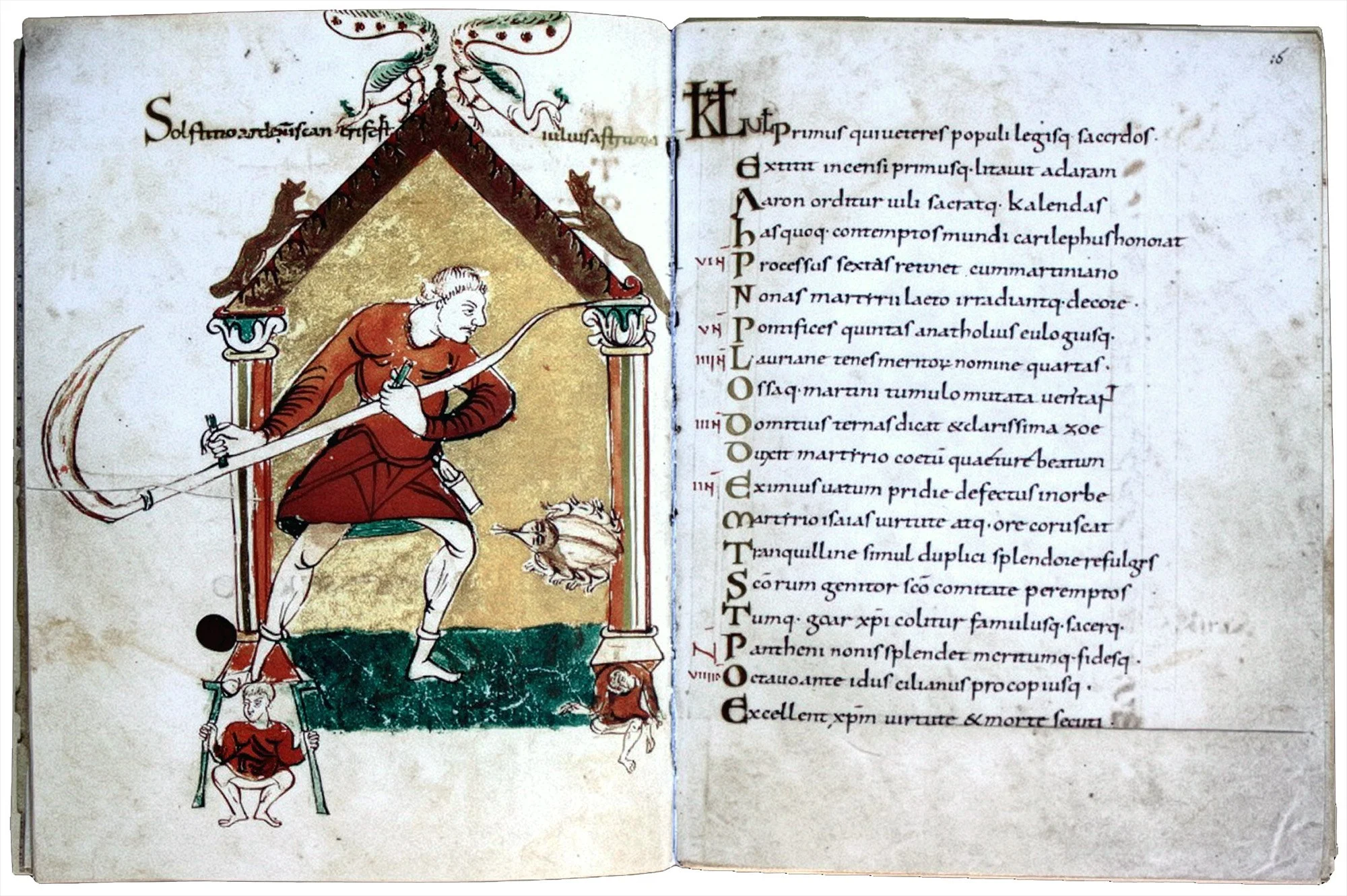
A page from the Martyrologium by Wandalbert of Prüm.
The relief captures that fusion. The artist surrounds Wandalbert with a visual rota—a wheel-of-the-year feeling. Side panels stage small dramas: an altar, a martyr’s triumph, a saint’s feast. The crisp little capitals on the right could be a folio margin, closing a December tale with a neat “explicit.”
813: when language shifted
The date on the base ties Wandalbert to a reforming moment. In 813 Charlemagne called regional councils and insisted that preaching be done in languages people actually spoke—rustica romana for Romance speakers and theodisca for the Germanic world. The policy was larger than sermons: teaching should be audible inside ordinary life. Wandalbert’s poems are an answer in miniature. He kept Latin’s music but bent it toward the village: tools and birds, market days and fast days, the sound of bells and the grind of the mill.
Reading the sculpture
The stone reads like a page. Wandalbert sits on a raised platform, one hand steadying a tablet, the other lifting his stylus as if listening for the next footbeat. A hinged drawing frame angles toward him—an artist’s tool turned into a metaphor for measuring time. Around the rim, saints stand in tiny arcades; below them twine vines and tools of work, hints of vineyards, fields, and mills.
On the right, the neat block script could be a folio margin: martyrs named, December called out, the closing “explicit” that ends a book. Even the little scales tucked near his knee suggest balance—of seasons and feasts, labor and prayer, prose and verse. It is both portrait and instrument: a man and the calendar he tunes.
What endures
Prüm’s abbey no longer governs estates the way it once did, but its grammar still orders the landscape. Parish boundaries, fair days, field names, and the memory of processions echo the monastic clock; the diocese remains the frame, the monastery the old metronome. Wandalbert’s poems feel unexpectedly practical: a theology of weather and work, bees and bread, written to be carried in the head.
That is the sculpture’s charge. It reminds us that culture is kept not by proclamations but by rhythms—what gets harvested when, when the fast begins, when the bell calls the village to sing. Prüm turned those rhythms into a public good; Wandalbert gave them music. Stand before the stone and you can feel the year begin to move.
Further Reading
Wandalbert of Prüm, Martyrologium (editions/translations)
The Prüm Polyptych (c. 893)
Regino of Prüm, Chronicle
Rosamond McKitterick, The Carolingians and the Written Word
Jean-Pierre Devroey, The Economy of the Carolingian Empire
Studies on the Councils of 813 and vernacular preaching
Research on the Sandals of Christ and the cult at Prüm
Surveys of Carolingian monasticism in the Rhineland–Ardennes