
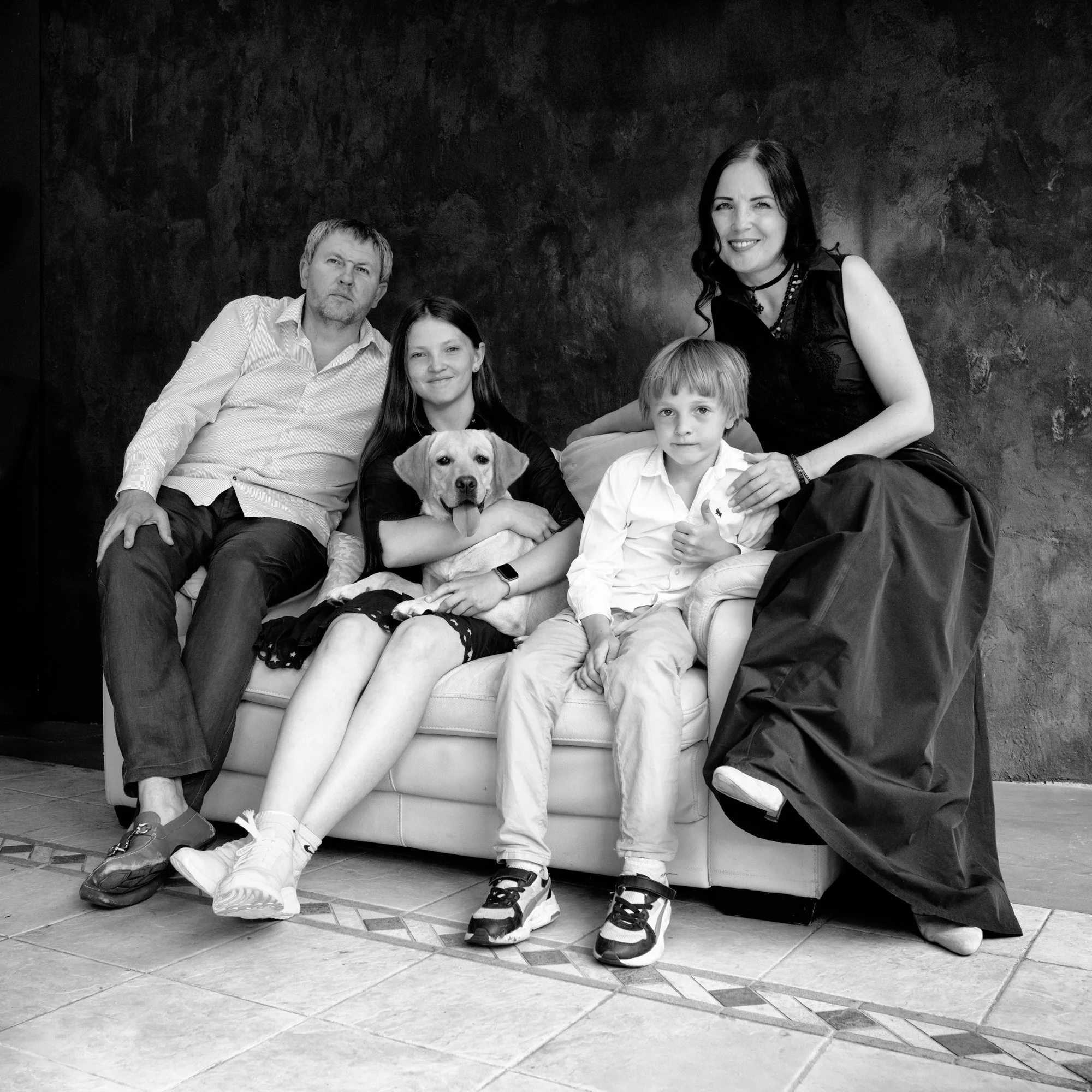
Hanna and her family in The Netherlands.
My name is Hanna and I’m from Dnipro, a large industrial city in eastern Ukraine. Until early 2022, I lived a full and successful life. I ran my own marketing and advertising agency, worked with major international brands, and was involved in social projects and campaigns. At the same time, I taught marketing, communication, and public relations at the university – something I truly enjoyed. Together with my husband and our three children, we lived a comfortable life. We were entrepreneurial, creative, and engaged in our city.
The unrest began already in 2014, during the Maidan Revolution. It affected me deeply. Young people flooded the streets, dreaming of a European future for Ukraine. That dream was violently crushed. I still remember crying every evening while watching the news. The deaths of young protesters felt personal. That was the moment I understood: we are a people who must fight for freedom, for justice.
When Russia invaded Ukraine on February 24, 2022, everything changed. Our whole family — sixteen people in total — took shelter in a basement. We didn’t live far from the Zaporizhzhia nuclear power plant, and when it came under fire, the fear really hit us. There were rumors of a possible nuclear disaster. Doctors gave instructions on television about how to apply iodine to children’s skin to protect them from radiation. My children saw the panic in my eyes. On the ninth day of the war, I made the decision: we had to flee.
We left Dnipro in five cars. Normally, the drive west would take ten hours — it took us five days. The roads were packed with people like us — desperate, afraid, heading into the unknown. We taped signs reading “CHILDREN” to our car windows, hoping Russian pilots would see we were innocent civilians.
Eventually, we made it to Roermond in the Netherlands, where an old friend offered us shelter. My husband stayed behind at first, to take care of his parents and our business. He only joined us in Roermond nine months later.
Once I arrived, I couldn’t sit still. That’s not who I am. I volunteered at my children’s primary school, working as an interpreter and piano accompanist. Later, I became a coach for Ukrainian employees at La Place, taught at Stedelijk College, and began working as a project leader at the Ukrainian House in Maastricht.
Since October 2023, I’ve been working as a counselor for Ukrainian families in Limburg. I help people integrate, with paperwork, schools, doctors, and government agencies. The work is intense, but rewarding. I know where they come from. I know what it means to leave everything behind.
I feel happy here. In Ukraine, we lived well, but life was stressful and competitive. Here, we’ve found peace. My children are integrated at school, my husband works as a chef, and we are slowly building something new. Still, the future is uncertain. I don’t know if we’ll be allowed to stay. That’s hard, but we do our best, we work, we contribute. We are happy here.
What I’ve experienced is not unique. Hundreds of thousands of Ukrainians carry stories like this. But I hope mine shows just how deeply war affects a human life — and how much strength it takes to start over, in a foreign land, with a foreign alphabet, but with the same hope: a safe life for our children.