history

From Iron Age Tribes to Digital Europe

The Turning Points That Changed Everything
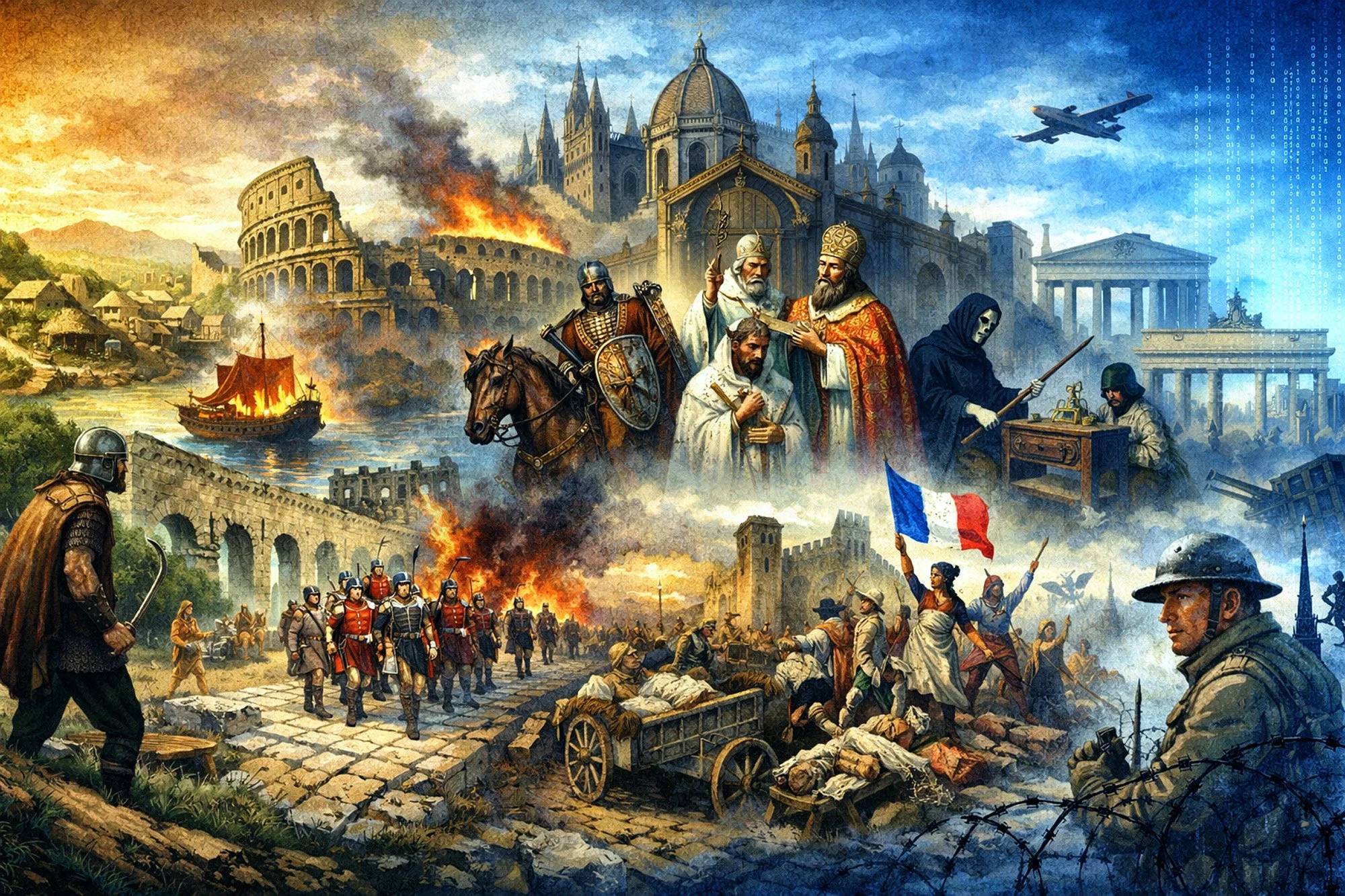
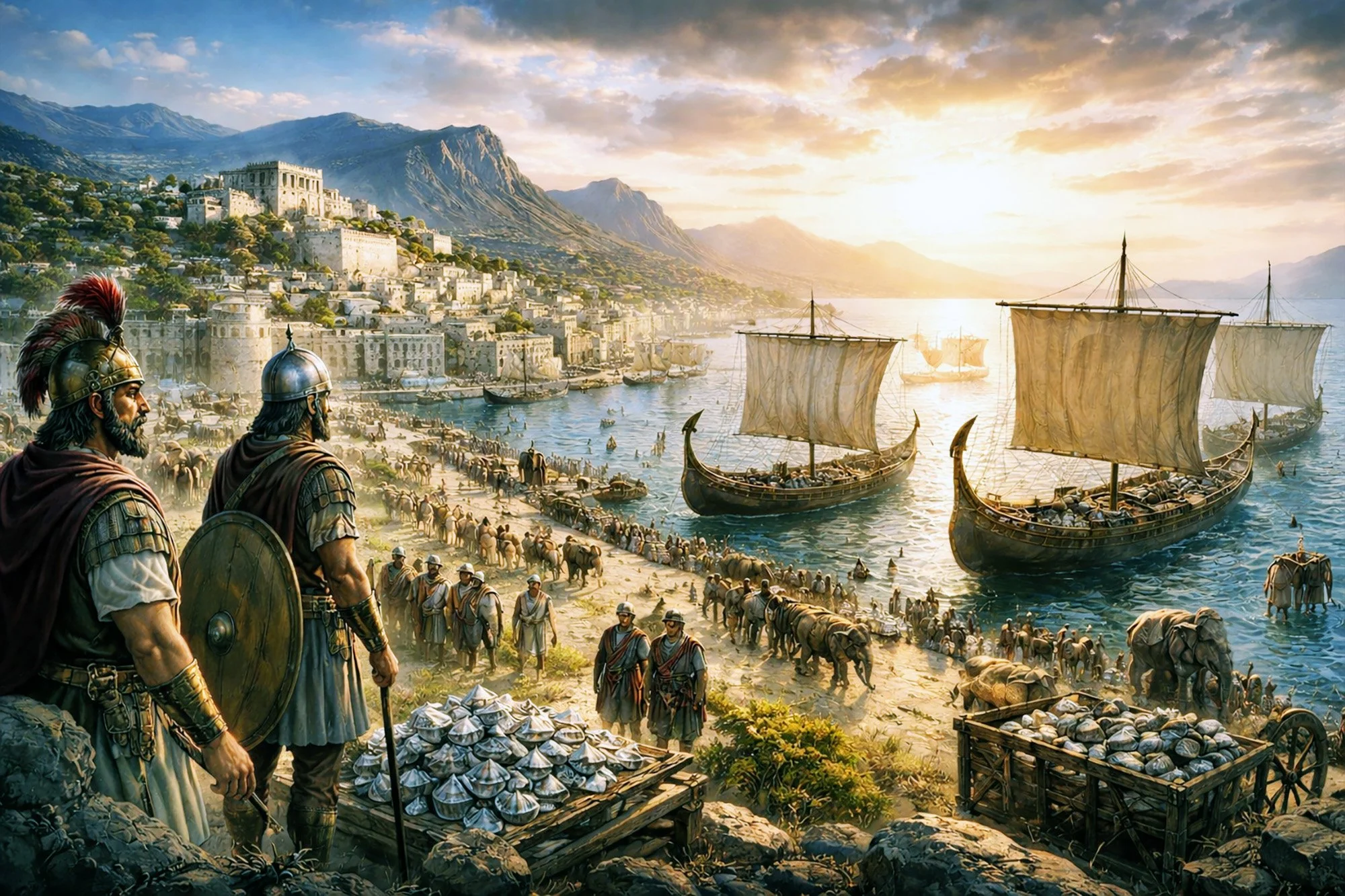
Image created with AI.

When we travel across Europe today, history often feels calm and continuous. Roman roads become medieval streets. Castles turn into hotels. Old kingdoms slowly transform into modern nations. Yet this impression is deceptive. Europe did not grow in a straight line. Again and again, long periods of tension built quietly beneath the surface. Then a relatively small event pushed societies over the edge.

If we want to understand Europe, we must look at these turning points.

The Iron Age and the Birth of European Diversity (around 800 BC)

Around 800 BC, Europe was not a unified civilisation but a mosaic of peoples and cultures. Celts, Iberians, Greeks, Etruscans and many others lived in networks of trade and rivalry. Iron technology spread, making tools and weapons more accessible. Trade routes connected the Mediterranean to the Atlantic and deep into the European interior. Wealth accumulated in new hands. Power became more concentrated.

This slow transformation was itself a tipping point. Europe moved from small, local communities to larger and more complex societies. Warfare became more organised. Long-distance exchange intensified. Cultural interaction increased. By the first millennium BC, Europe was already a connected world, restless and dynamic. The stage was set for a power capable of linking these regions into a single system.

Rome: Crisis as the Trigger for Empire

Rome was not destined to dominate Europe. For centuries it was simply one city among many in central Italy. Its rise was not inevitable. What changed was a series of existential crises that forced Rome to innovate. Surrounded by rivals, it developed flexible political institutions and a remarkable capacity to form alliances.

The decisive trigger came with the wars against Carthage in the third and second centuries BC. These conflicts pushed Rome beyond its limits. To survive, it mobilised unprecedented resources, built large fleets, and organised armies on a scale never seen before in the western Mediterranean. Victory over Carthage removed its greatest rival and gave Rome control over key trade routes and territories.

From that moment, the balance of power shifted. Expansion followed. Roads, colonies, and law spread across Europe. What had begun as a defensive struggle became an imperial system. For the first time, large parts of Europe shared infrastructure, administration and political frameworks. Cooperation and conquest became two sides of the same process.

The Fall of Rome and the Return of Fragmentation

The collapse of the Western Roman Empire in the fifth century is often imagined as a dramatic moment. In reality, decline had been gradual. Economic strain, migration, political instability and internal conflict slowly weakened the system. When a Germanic leader deposed the last Western emperor in 476, the event itself was almost symbolic. The real transformation had already taken place.

Yet the consequences were enormous. Europe fragmented into regional kingdoms. Local identities re-emerged. The central question became how to create order without empire. This challenge shaped the next thousand years.

Clovis and the Fusion of Cultures

Around the year 500, the Frankish king Clovis chose to adopt Catholic Christianity. Many other Germanic rulers followed different forms of the faith. His decision helped bridge the gap between Roman populations and new rulers. It strengthened cooperation between political power and the Church.

This was a small choice with large consequences. It laid foundations for medieval Europe and helped create a shared cultural framework that would endure for centuries.

Charlemagne and the Idea of Europe

In the year 800, Charlemagne was crowned emperor. His empire did not survive long, but the idea did. Europe began to see itself as a civilisation rooted in shared learning, religion and governance. Administration, education and communication were revived. The political geography of modern Europe began to take shape.

This moment shows how ideas can outlive institutions.

The Black Death: Catastrophe and Renewal

In the fourteenth century, plague devastated Europe. Yet it struck a society already under pressure. Population growth had strained resources. Feudal structures were rigid. The sudden loss of labour changed everything. Wages rose. Social mobility increased. Old hierarchies weakened.

Crisis became a catalyst for transformation. Europe emerged more dynamic and more flexible.

The Reformation and the Power of Networks

When Martin Luther challenged the Church in 1517, he did not intend a continental revolution. But printing, urban communication and political rivalry spread his ideas rapidly. Europe divided into competing systems. States gained strength. Individual belief became central.

Once again, long-term tensions combined with a triggering event.

Revolution and modern politics

The French Revolution transformed Europe. It introduced citizenship, rights and nationalism. Yet it grew from structural pressures: debt, inequality and social frustration. A political crisis ignited forces that reshaped the continent.

Modern Europe was born in this period of turmoil.

War and the Search for Cooperation

The twentieth century brought destruction on an unprecedented scale. Two world wars devastated Europe. Yet the response was not endless conflict. Instead, European leaders chose cooperation. Institutions replaced rivalry. Law replaced revenge. Integration became a strategy for survival.

This was perhaps Europe’s most surprising turning point.

1989 and the Reopening of the Continent

The fall of the Berlin Wall symbolised the end of division. Communist regimes had weakened for years, but small events accelerated change. Courage, communication and timing reshaped the political landscape. Europe reunited in ways few had predicted.

The Digital Age: a New Tipping Point

Today Europe faces another transformation. Globalisation, migration, climate change and digital technology are reshaping society. Social media amplifies emotions. Trust in institutions fluctuates. New communities emerge beyond borders.

The outcome remains uncertain. But history suggests that change will not be smooth. It will come through moments of crisis and renewal.

What Europe Teaches Us

Europe’s story is not only about conflict. It is about adaptation. Again and again, societies have faced collapse and uncertainty. Again and again, they have developed new forms of cooperation. Stability has never been permanent. Community has always had to be rebuilt.

For travellers, this perspective adds depth to every journey. Roads, villages and cities are not just heritage sites. They are the result of countless turning points. Europe is not a finished civilisation. It is an ongoing experiment.

And we are part of its next chapter.

Further Reading

  • Brian Klass, Fluke: Chance, Chaos and Why Everything We Do Matters

  • Christopher Dawson, The Making of Europe

  • Peter Heather, Empires and Barbarians

  • Ian Morris, Why the West Rules – For Now

  • Peter Turchin, Ages of Discord

  • Niall Ferguson, Civilization
The Punic Wars: How Carthage Rebuilt Its Power in Iberia

Image created with AI

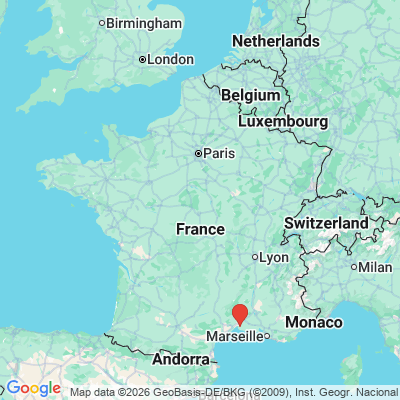
Travel today through southern and eastern Spain—from Cádiz to Cartagena, and along the coast near Alicante—and you are moving through landscapes that once played a central role in one of the greatest conflicts of the ancient Mediterranean.

Between 264 and 146 BC, Rome and Carthage fought three major conflicts known as the Punic Wars. These wars determined who would dominate the Mediterranean world for centuries. Yet one of the most important chapters of this story unfolded not in Italy or North Africa, but in Iberia, along the coasts and mining regions of what is now Spain.

The First Punic War

The rivalry began in 264 BC on the island of Sicily. Rome intervened in a local dispute and soon found itself at war with Carthage, the dominant maritime power of the western Mediterranean.

The conflict lasted 23 years. Rome, originally a land power, even built massive fleets to challenge Carthage at sea. In 241 BC, Rome finally won, forcing Carthage to surrender Sicily and pay a heavy indemnity. Soon afterwards Rome seized Sardinia, leaving Carthage weakened and humiliated. The First Punic War

But Carthage was not finished.

Turning to Iberia

After the war the city nearly collapsed during a rebellion of unpaid mercenaries. The general who saved it was Hamilcar Barca, a commander who had fought Rome in Sicily.

Hamilcar understood that if Carthage ever wanted to challenge Rome again, it needed new resources—especially money and soldiers. He found both in Iberia.

Phoenician traders had long been active along the Iberian coast. One of their oldest settlements was Gadir, modern Cádiz, founded centuries earlier as a trading port linking the Atlantic and Mediterranean. But in the 230s BC, Hamilcar began transforming Carthaginian influence in Spain into a real territorial power.

The region’s silver mines filled Carthage’s treasury, and Iberian warriors joined its armies.

Carthaginian Cities in Spain

Hamilcar’s successors continued this expansion. His son-in-law Hasdrubal the Fair founded a new Carthaginian capital in Iberia: Carthago Nova, today’s Cartagena.

The city had an exceptional natural harbor and lay close to the mining districts that financed Carthage’s growing power.

Further north along the coast lay Akra Leuke, usually identified with the area around modern Alicante. According to ancient sources, Hamilcar himself established a Carthaginian base here during his early campaigns in Iberia.

Together with Cádiz and Cartagena, these cities formed the backbone of Carthage’s Spanish power.

Among the young men growing up in this frontier world was Hamilcar’s son: Hannibal.

Hannibal’s Iberian War Machine

Hannibal spent much of his youth in Iberia, surrounded by soldiers and tribal allies from across the peninsula. The armies he would later command included large numbers of Iberian warriors, and Spain’s silver financed his campaigns.

In 218 BC, at the start of the Second Punic War, Hannibal marched from Carthaginian Spain across the Pyrenees and eventually over the Alps into Italy — accompanied, according to ancient accounts, by African forest elephants.

For years he defeated Roman armies, winning famous victories such as Cannae in 216 BC.

Yet even Hannibal could not destroy Rome.

Why Rome Survived

Rome’s strength lay in its political and military system. Roman commanders rotated regularly, creating a steady supply of competent leaders rather than relying on a single genius.

Even more important was Rome’s network of allies across Italy. These communities supplied vast numbers of soldiers, allowing Rome to rebuild its armies again and again.

Over time this system wore Hannibal down. Rome eventually defeated Carthage in 202 BC, and in 146 BC the city itself was destroyed.

Iberia’s Forgotten Role

Today the Punic Wars are often remembered for Hannibal’s dramatic march across the Alps.

But the deeper story runs through Spain.

From the ancient Phoenician port of Cádiz, to the Carthaginian stronghold of Cartagena, and the early military base near Alicante, Iberia became the place where Carthage rebuilt its power after defeat.

It was here that the silver, soldiers, and strategy emerged that allowed Hannibal to challenge Rome—and nearly change the course of Mediterranean history.

The Celts: Europe’s First Cultural Network

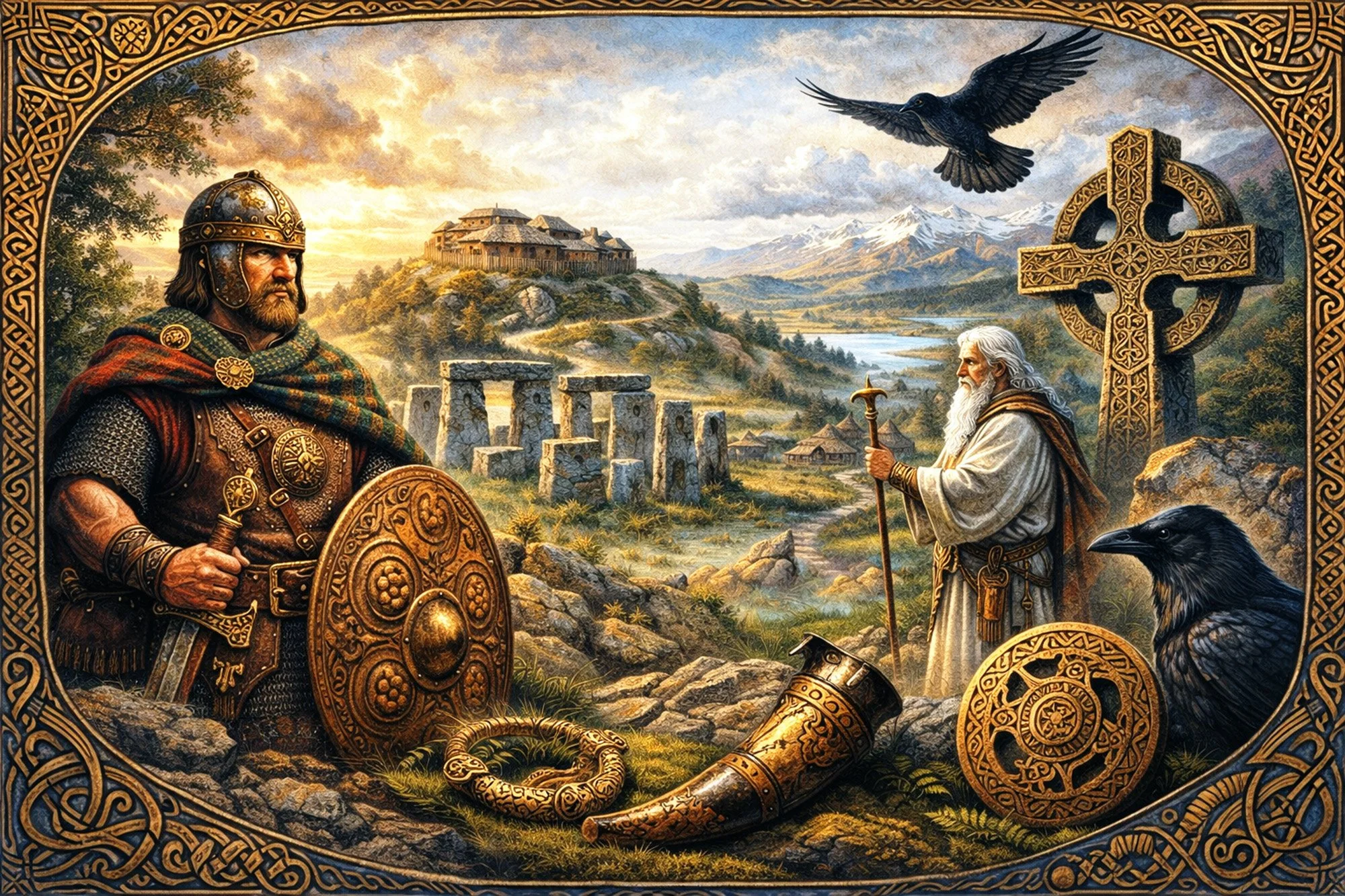
Image created with AI

When we travel slowly across Europe — as many culture lovers do — we begin to notice something curious. Landscapes change, languages shift, cuisines evolve. Yet certain patterns return: hilltop settlements, spiral motifs, sacred springs, warrior legends. Part of this shared layer goes back to a people who never built an empire and never wrote their own history, but who shaped Europe in lasting ways: the Celts.

A Cultural Europe Before Political Europe

The Celts were not one nation. They were a wide network of tribes who shared languages, beliefs, artistic styles and ways of life. At their height, they spread from Ireland to Anatolia in modern Turkey.

What they created was something like a cultural Europe long before any political unity existed. They travelled, traded, fought, and mixed with local populations. Rather than replacing earlier cultures, they blended with them. This is why so many regions in Europe still feel both different and strangely connected.

From Alpine Origins to a Continent

Their earliest roots lie in the Alpine world of the early Iron Age. These were skilled farmers, miners and traders. Salt, copper and tin brought wealth. Trade connected them to the Mediterranean, and prosperity encouraged expansion.

Over centuries, Celtic groups moved into Gaul, Iberia, the British Isles and Central Europe. They helped shape early versions of cities that would later become Paris, Lyon, Vienna and London. In many places, hybrid cultures emerged. In Spain, for example, Celtiberian societies combined Celtic and Iberian traditions.

Europe, even then, was a layered landscape.

Warriors, Poets and Craftsmen

Ancient writers often focused on Celtic warfare, but archaeology reveals a more complex society. The Celts valued beauty, craftsmanship and storytelling. Their jewellery and weapons were highly sophisticated. Poets and musicians held respected roles. Druids acted as religious leaders, judges and teachers.

Trade and craftsmanship were prestigious paths. Metalworkers and merchants enjoyed status close to that of elites. This world encouraged individuality and self-expression — something that still resonates in Europe’s regional cultures today.

Why They Never Built an Empire

Despite their vast reach, the Celts never formed a unified state. Loyalty remained local. Rivalries between tribes were frequent. When Rome expanded, Celtic resistance was fierce but fragmented.

The Romans brought organisation, discipline and long-term strategy. Gradually, most Celtic regions were absorbed. Yet conquest did not erase local traditions. Instead, Roman structures blended with Celtic cultures, creating new forms of society across Europe.

A Legacy That Never Disappeared

By the early centuries of our era, Celtic political power had faded. But their cultural influence remained. Languages survived in Ireland, Scotland, Wales and Brittany. Myths and artistic traditions shaped medieval Europe. Place names, landscapes and festivals still carry their imprint.

The Celtic story reminds us that Europe was never built only by empires. It grew through movement, exchange and cultural mixing. In that sense, the Celts were among the first to live the reality of a connected yet diverse continent.

If we travel with curiosity, we can still see their traces — not as isolated ruins, but as part of a shared European memory.

Further Reading

  • Barry Cunliffe — The Ancient Celts

  • Miranda Aldhouse-Green — The Celtic World

  • John Collis — The Celts: Origins, Myths and Inventions

  • Archaeological guides to major Celtic sites such as Hallstatt, Bibracte and Numantia

When Republics Drift: Tacitus and the Politics of Our Time

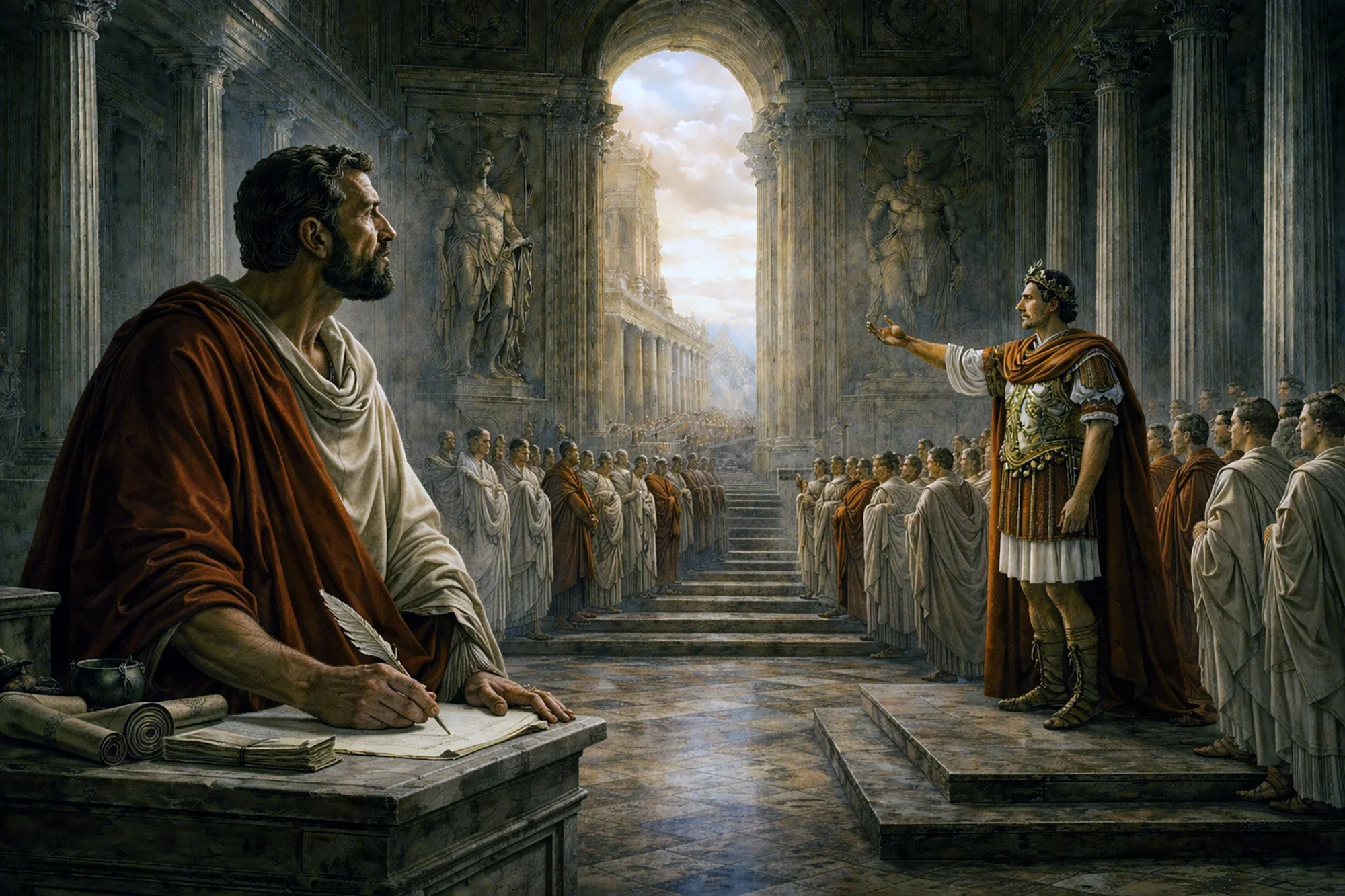
Image created with AI.

Around the year 100 AD, the Roman historian Tacitus looked back on the political world he had lived through and saw something unsettling. Rome still had its Senate. Laws were debated, magistrates held office, and the language of republican government survived. Yet everyone understood that real power now rested with the emperor—whether under Tiberius, Nero, or later Domitian.

Tacitus captured this transformation with quiet precision. Rome had not suddenly abandoned its republican institutions. Instead, those institutions had slowly adapted to a new reality in which authority was increasingly concentrated.

For modern readers, that observation feels strikingly familiar. Across the democratic world—particularly in the United States—political debates increasingly revolve around the strength of institutions, the limits of executive power, and the resilience of constitutional systems. Tacitus does not offer a blueprint for the present. But his histories reveal a recurring pattern in political life: freedom rarely disappears through dramatic collapse. It fades gradually, while institutions continue to function.

A Senator Writing After the Republic

Tacitus was not an outsider observing Rome from afar. He was a senator who had served under several emperors, including the authoritarian reign of Domitian. His career unfolded in a political system where public institutions still existed, but where criticism of imperial authority could be dangerous.

After Domitian’s death, Tacitus began writing his great historical works, including The Histories and The Annals. These books explore the early decades of the Roman Empire and the reigns of emperors such as Tiberius, Nero, and others who shaped the imperial system.

What makes Tacitus remarkable is not only what he records, but how he interprets it. His histories are less concerned with battlefield drama than with the mechanics of power: how rulers influence institutions, how elites behave in changing political environments, and how a political culture gradually adjusts to new realities.

Institutions That Remain, but Change

Rome did not lose its republican structures overnight. The Senate continued to meet and to vote. Courts functioned. Public ceremonies preserved the appearance of the old order.

Tacitus shows how these institutions slowly evolved under imperial authority. Emperors shaped the political climate in which decisions were made. Legal mechanisms could be used to silence rivals. Public debate became more cautious as people learned where the true boundaries of power lay.

What makes Tacitus’ account so compelling is his restraint. He rarely launches direct attacks on the system. Instead, he describes events carefully, allowing readers to see how authority shifts even while institutions outwardly survive.

The Quiet Adaptation of Elites

A central theme in Tacitus’ work is the behavior of Rome’s political elite.

The Senate once stood at the center of Roman public life. Under the empire, it continued to exist but operated within a system dominated by the emperor. Senators responded in different ways. Some openly praised imperial authority. Others remained silent. A few attempted resistance and paid a heavy price.

Tacitus portrays these figures with striking nuance. They are not simply villains or heroes. Many are pragmatic individuals navigating a system that has fundamentally changed.

This raises one of Tacitus’ most uncomfortable questions: when freedom erodes, is it only because rulers seize power—or also because elites adapt to the new order?

A Lens for the United States—and Beyond

Tacitus does not tell us that modern republics will follow the same path as Rome. History never repeats itself so neatly. But his work offers a powerful framework for thinking about political change.

In the United States, institutions remain strong and deeply rooted. Congress legislates, courts interpret the law, and elections regularly shift political power. Yet debates about executive authority, the role of the judiciary, and the stability of democratic norms have become increasingly central to American political life. Presidents rely more frequently on executive orders and emergency powers. Political battles over the courts have intensified. Trust between branches of government has grown more fragile. None of these developments mean that the American republic is destined to follow Rome’s path. But Tacitus reminds us that the health of institutions depends not only on laws and constitutions. It also depends on political habits, expectations, and the willingness of elites to respect the limits of power.

These tensions are not unique to the United States. Across Europe and other parts of the world, societies are also debating the balance between strong leadership, institutional independence, and democratic accountability.

Tacitus helps us see why these debates matter.

The Slow Drift of Political Systems

Tacitus never wrote a formal theory of politics. Yet his histories contain one of the most enduring observations about power.

Political systems rarely collapse overnight. The greater danger lies in gradual change: the expansion of authority in times of crisis, the normalization of exceptional powers, and the quiet adaptation of institutions to new political realities. By the time these shifts become obvious, the system itself has already evolved.

That insight, drawn from the experience of ancient Rome, continues to resonate today. Tacitus reminds us that republics are not only sustained by laws and institutions. They are sustained by the political culture that surrounds them.

When that culture changes, freedom can fade—even while the structures of government remain.

Further Reading

  • Tacitus – The Annals

  • Tacitus – The Histories

  • Tacitus – Agricola

  • Tacitus – Germania

  • Ronald Syme – Tacitus

  • Christopher Kelly – The Roman Empire: A Very Short Introduction

  • Miriam Griffin – Nero: The End of a Dynasty

  • Anthony Everitt – The Rise of Rome

Living on the Fault Line: A French Paratrooper in Germany around 1980

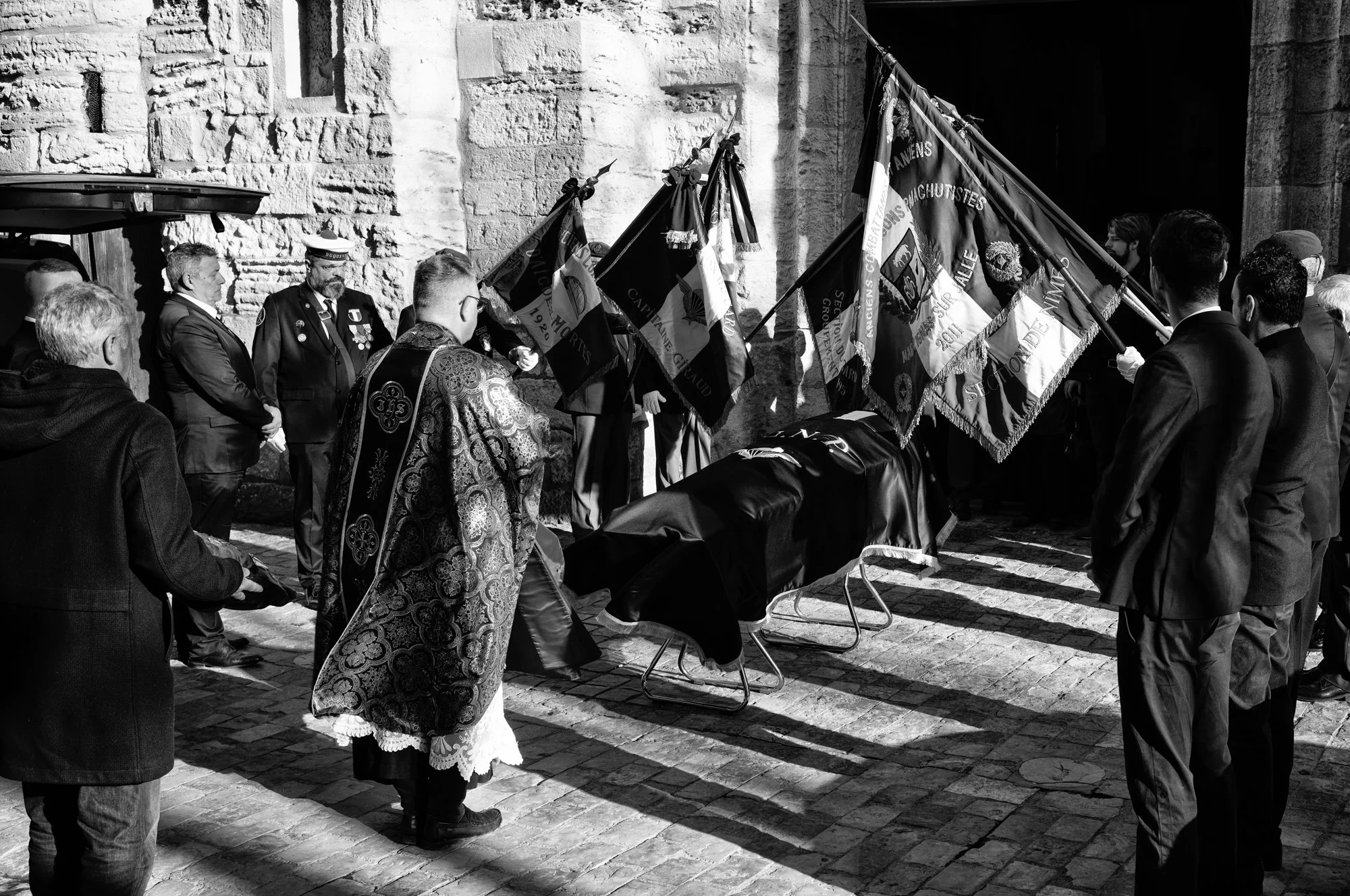
At the funeral of Jean Lacombe (1943 - 2026) at the Eglise Notre-Dame des Sablons in Aigues-Mortes (France, 3 feb. 2026). Jean Lacombe served in the 80s with the 12e Régiment de Cuirassiers in Germany (5e escadron, 1er peloton) and was later associated with the 13e Régiment de Dragons Parachutistes and the Union Nationale des Parachutistes (UNP), as part of the Forces françaises en Allemagne.

In the late 1970s and early 1980s, Europe lived with a quiet tension that shaped everyday life in ways that are easy to forget today. There was no shooting war, no ruins in the streets—but the expectation of war was always present, like bad weather on the horizon. For thousands of French soldiers stationed in West Germany, this was not theory. It was routine.

A man serving in a regular French unit such as the 12e Régiment de Cuirassiers around 1980 lived and trained on what was, in practical terms, the front line of the Cold War.

Why Germany?

After the Second World War, Germany became the hinge of Europe. West Germany faced the armies of the Soviet-led Eastern Bloc across a heavily fortified border. If a war were to begin, it would begin there. France therefore stationed large forces in Germany as part of a long-term strategy of deterrence: war would be prevented by making it too costly to start.

These forces were known as the Forces françaises en Allemagne—French forces permanently deployed on German soil. They were not occupiers, and not guests either. They were a standing reminder that Europe expected the worst and prepared accordingly.

Daily Life Under Permanent Readiness

For a soldier of the 12e RC—an armoured cavalry regiment—the rhythm of life was demanding and repetitive by design. Training was constant. Vehicles had to be ready, crews drilled, procedures rehearsed again and again. Exercises often simulated sudden escalation: alarms in the night, rapid mobilisation, columns moving out before dawn.

The logic was simple. If war came, there would be no time to improvise.

Yet daily life was not cinematic. It involved long stretches of waiting, maintenance, instruction, and routine discipline. Soldiers lived in barracks or nearby towns like Müllheim, often with families. Children went to French schools, groceries were bought locally, and weekends were sometimes spent crossing borders that today feel trivial but then carried enormous symbolic weight.

Normal life, lived under abnormal assumptions.

What Was He Training For?

Contrary to popular images of nuclear apocalypse, most soldiers trained for conventional war: tanks, reconnaissance, delaying actions, manoeuvre. The expectation was that any conflict would begin as a fast-moving conventional clash before escalation was even considered.

For cavalry units like the 12e RC, this meant mobility and information. Knowing where the opponent was mattered as much as firepower. Units trained to move quickly, observe, report, and—if necessary—fight while buying time for larger formations.

Nothing about this was abstract. Maps were studied with real villages on them. Rivers were crossed that still exist today. Routes were memorised because, in wartime, they would become lifelines or death traps.

France and NATO: Close, But Not the Same

One complexity often forgotten is that France, at this time, was not part of NATO’s integrated military command. That did not mean neutrality. French forces coordinated closely with allies but retained national control.

For soldiers, this meant a double identity: defending Western Europe alongside allies, while operating under a distinct French doctrine and command structure. Pride in independence was strong—but so was awareness of shared risk.

UNP: Brotherhood After the Uniform

Many of these soldiers later became active in the Union Nationale des Parachutistes (UNP). By the time they joined veterans’ organisations, the Cold War had ended. The wall fell. Barracks closed. Germany reunified.

But the shared experience remained.

UNP membership was not about nostalgia for conflict. It was about preserving a lived understanding of service in a period when peace depended on preparation for catastrophe. The ceremonies, the discipline, the insistence on memory—all grew from years spent training for a war that everyone hoped would never come.

A Life Shaped by Readiness

To serve in Germany around 1980 was to live with contradiction: stability built on constant alert, normal family life framed by contingency planning, peace maintained through the acceptance of potential destruction.

For those who stood watch there, history did not arrive with explosions. It arrived quietly, through decades of restraint.

And that restraint—rarely celebrated, never dramatic—may be one of Europe’s most significant achievements.

Clovis and the World He Lived In: Europe Between Empire and Kingdoms

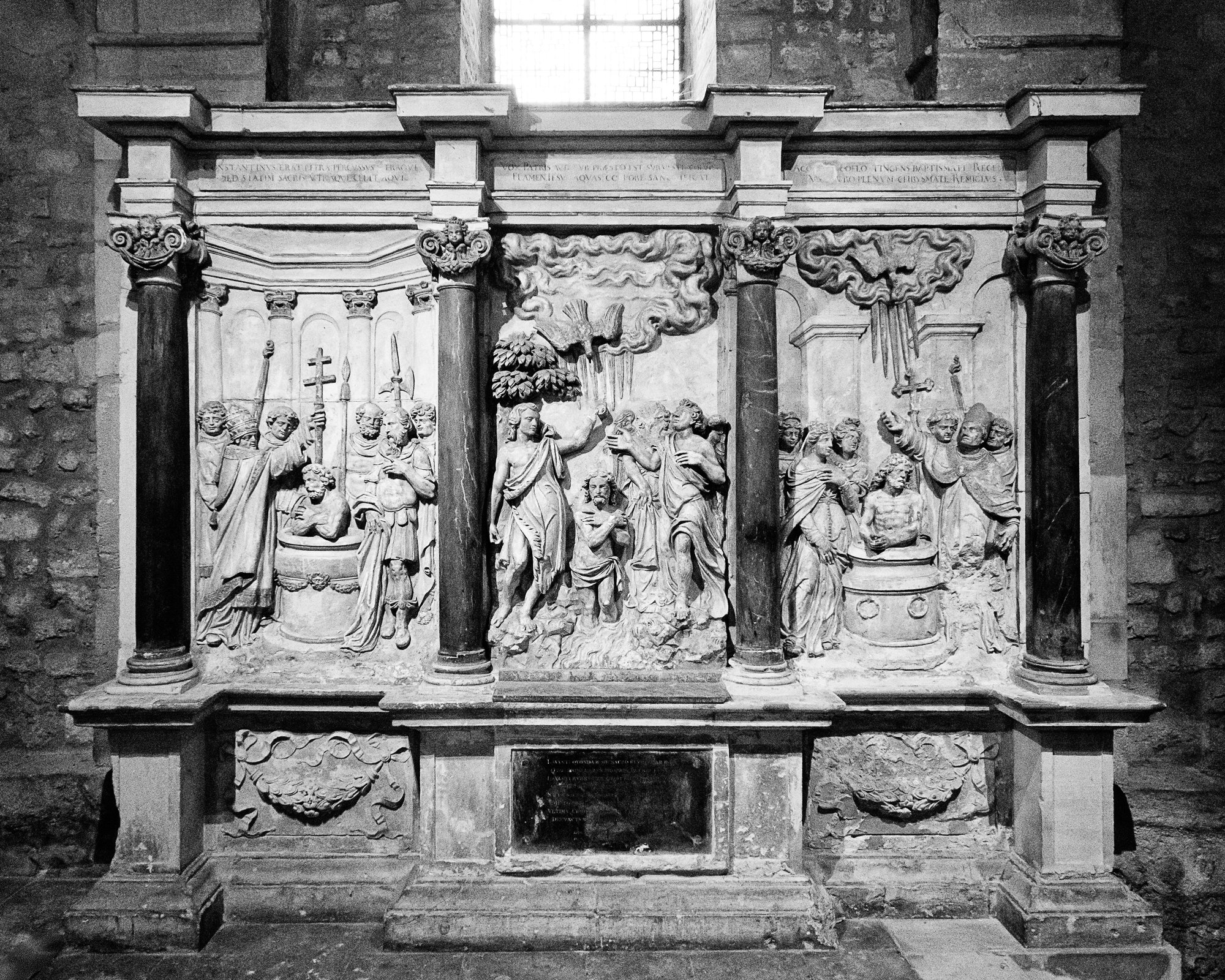
Retable des Trois Baptêmes, 1610 — Basilique Saint-Remi, Reims (France), attributed to Nicolas Jacques

This monumental altarpiece can be seen today in the Basilica of Saint-Remi in Reims, one of the most important historic churches of France. It was created in 1610 and is usually attributed to the local sculptor Nicolas Jacques. The work stands in the former baptistery area of the church, where generations of visitors have encountered it as both a religious and historical statement.

The altarpiece depicts three key baptisms that together tell a powerful story. In the centre, Christ is baptised in the River Jordan by John the Baptist, representing the spiritual foundation of Christianity. On the left, the Roman emperor Constantine receives baptism, symbolising the moment when Christianity moved from a persecuted faith to a religion supported by imperial power. On the right, the Frankish king Clovis is baptised by Saint Remi in Reims, an event traditionally seen as the birth of Christian France. The work therefore presents not only a religious message, but also a political one: it connects faith, authority, and the formation of European identity through a visual narrative that links the origins of Christianity to the emergence of Christian kingdoms in Europe.

If you travel across Europe today — from the Rhine valley to northern France — you move through landscapes shaped by a long and uncertain transformation rather than a single dramatic event. Somewhere between the fading structures of the Roman world and the emergence of medieval kingdoms, a young Frankish leader named Clovis rose to prominence. His name is often linked to the birth of France, but his real importance lies elsewhere. Clovis lived at a moment when old certainties were disappearing and new forms of power, identity and belief were still being invented.

A World in Flux

The centuries before Clovis were not simply the “fall of Rome.” They were a period of slow change. The Roman Empire did not collapse overnight. Instead, it adapted, fragmented and gradually lost direct control over large parts of its western provinces.

One symbolic moment often mentioned is the winter of 406. Groups such as Vandals, Suebi and Alans crossed the frozen Rhine. Yet this was not the first time such groups had entered the Empire. The crucial difference was that this time many stayed. New communities settled inside the Roman world and became part of it. The old frontier between “Romans” and “barbarians” began to dissolve.

Gaul, the region that roughly corresponds to modern France, became a mosaic of peoples. Goths ruled in the south, Burgundians in the Rhône valley, and various Frankish groups lived along the Rhine. Many of these leaders still served the Roman Empire as allies or military commanders. They were not outsiders attempting to destroy a civilisation. They were participants in a changing imperial system.

In this new world, identities were flexible. A man could be a Frank, a Roman citizen and a soldier at the same time. Borders mattered less than loyalties, alliances and opportunities.

Violence, Crisis, and Opportunity

The 5th century was a time of insecurity, but also of innovation. Wars, migrations and power struggles reshaped society. Local elites struggled to maintain order. Cities declined in the north. Central authority weakened.

At the same time, new political models emerged. Leaders who had once commanded Roman troops began to take on civil responsibilities. When imperial administration disappeared in some regions, local strongmen became protectors, judges and negotiators.

This was not universal collapse. In many areas daily life continued. People farmed, traded, prayed and adapted. Christianity spread and became a powerful source of cohesion. Bishops, monks and saints increasingly played roles once held by imperial officials.

The Roman Empire itself did not simply vanish. Even after the famous year 476, many rulers in the West still recognised the emperor in Constantinople. Coins, laws and political language continued to reflect Roman traditions.

The world was changing, but its foundations remained deeply Roman.

The Franks: Not One People, but Many

The Franks were not originally a single nation. The name itself was given by Roman authors to various groups living near the Rhine. These communities could unite or divide depending on circumstances. They were farmers, warriors, traders and often Roman soldiers.

Over time their leaders gained prestige. Some served the Roman army. Others fought against it. Many did both. Their world was shaped by constant contact with Rome: military organisation, wealth, religion and political ideas all flowed across the frontier.

Clovis inherited this complex world. His father, Childeric, was likely both a Frankish leader and a Roman military commander. He operated within the late Roman system even as it weakened.

Clovis in His Own Time

When Clovis came to power around 481, imperial authority in north-western Europe had already become regional and fragmented. The scale of his domain was modest compared with the Roman Empire, and for most of his contemporaries he was simply one regional leader among many.

His achievement was not the creation of a vast empire, but the consolidation of power in northern Gaul. He managed to unite different Frankish groups, defeat rival rulers and expand his influence. He built a durable political centre in a landscape where authority had become local rather than imperial.

Perhaps his most decisive move was religious.

The Conversion That Changed Europe

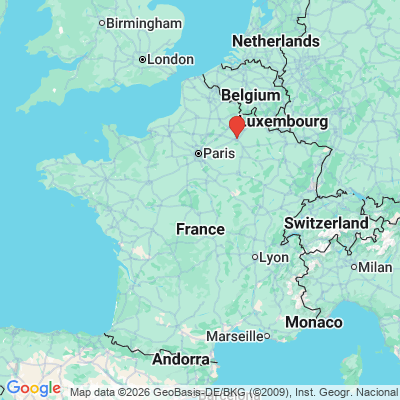
Most rulers in the post-Roman West were already Christian, but many followed Arian Christianity, which differed from the Catholic faith of most Roman communities in Gaul. Clovis’ decision was therefore not simply between paganism and Christianity, but between different forms of the faith. Influenced in part by his wife Clotilde, a Catholic Burgundian princess, he increasingly leaned toward Catholic Christianity. Around the year 500, he was baptised in Reims by Bishop Remigius, a moment that marked both a personal conversion and a political alignment with the Catholic elites of Gaul.

This was a strategic decision. It aligned him with the Roman elites, bishops and urban communities of Gaul. It gave him legitimacy among the population he ruled. It opened alliances that strengthened his position.

Yet this choice was not inevitable. His family was religiously diverse. Pagan traditions still existed. The religious world of the time was fluid and contested.

His conversion helped create a new political and cultural synthesis: Roman, Christian and Frankish.

From Imperial Regions to Medieval Europe

Clovis did not replace the Roman Empire, nor did he rule anything close to its scale. What makes his reign significant is that it illustrates a broader transformation. Across western Europe, imperial authority was giving way to regional kingdoms that preserved many Roman practices while adapting them to new realities.

Clovis’ kingdom was one of several such experiments. But it proved durable. His successors maintained and expanded it. Over time this political structure became the foundation for later Merovingian and Carolingian power, shaping the development of western Europe for centuries.

The importance of Clovis therefore lies less in conquest and more in continuity and adaptation. He worked within the inherited Roman world, but in a context where power was local, identities were layered and institutions were evolving.

Why Clovis Still Matters

Clovis lived in a transitional age. His story shows that history is rarely about sudden collapse. It is about people navigating uncertainty, combining old traditions with new opportunities.

The Europe we know today — with its mixture of continuity and change, shared heritage and regional diversity — emerged from this long process.

Understanding Clovis means understanding that transformation.

Further Reading

  • Jeroen Wijnendaele, The World of Clovis

  • Peter Brown, The World of Late Antiquity

  • Gregory of Tours, History of the Franks

  • Guy Halsall, Barbarian Migrations and the Roman West

  • Chris Wickham, The Inheritance of Rome

From Hunger to Guillotine: The French Revolution

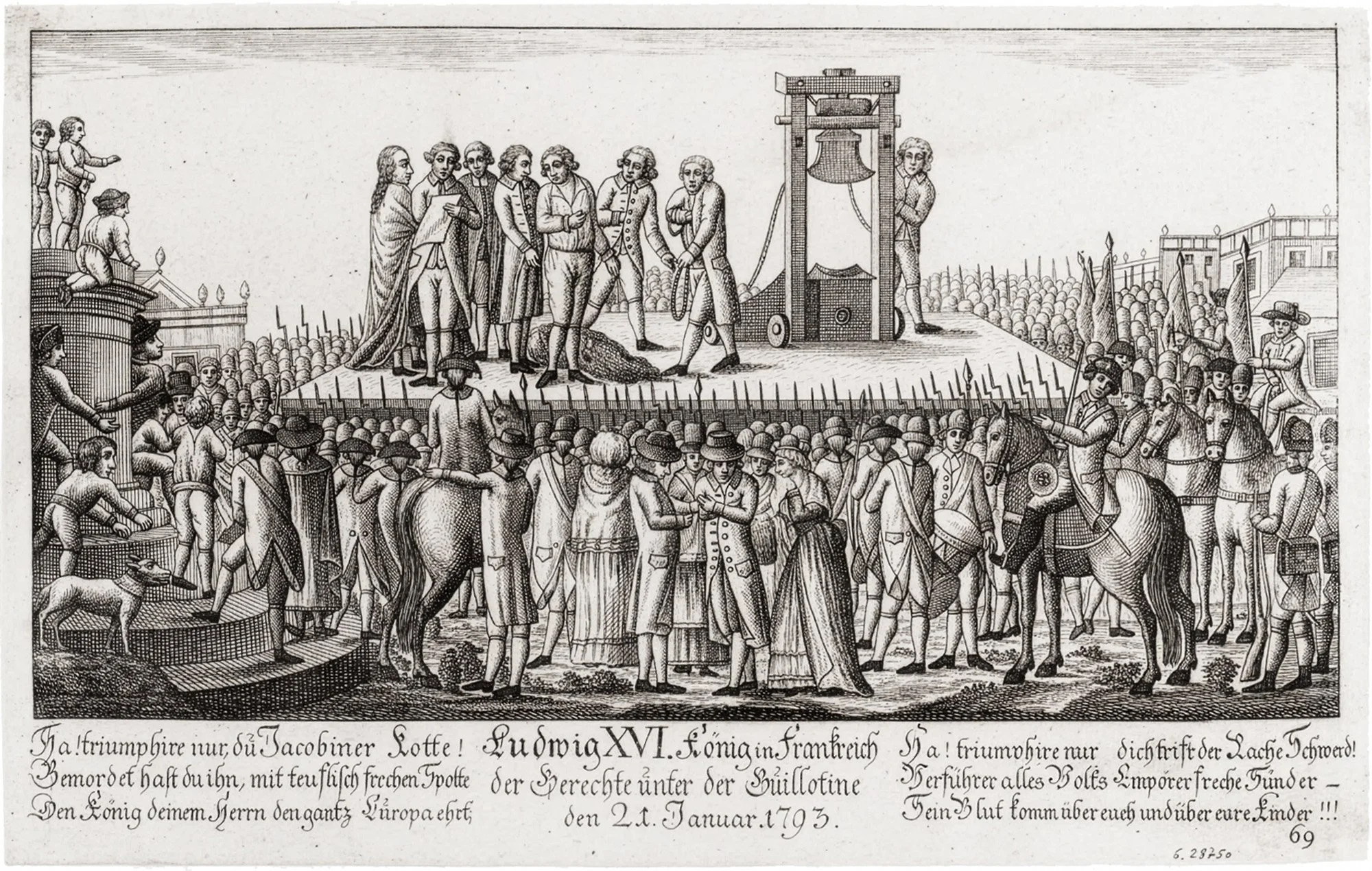
Execution of Louis XVI at the Place de la Révolution, Paris, 21 January 1793. Contemporary engraving.

Europe likes to imagine its revolutions as clean turning points: old world out, new world in.
The French Revolution was nothing of the sort. It was noisy, contradictory, intoxicating—and deeply human. It did not begin with blood, but with paper: with lists of complaints, with hunger, with words that—once printed and repeated—acquired a force of their own.

A Pressure Cooker Ready to Burst

By the late 1780s, France was a kingdom running on fumes. Decades of war had hollowed out the treasury: the War of the Austrian Succession (1740–1748), the Seven Years’ War (1756–1763), and—most ruinously—financial and military support for the American War of Independence. Victory abroad had produced bankruptcy at home.

The tax system deepened the fracture. Nobles and clergy enjoyed exemptions, while peasants and urban labourers carried the fiscal burden. Bread—always bread—had become scarce and ruinously expensive after poor harvests in 1787–1788. Hunger ceased to be private suffering and became public anger.

Material hardship alone, however, does not make a revolution. What truly destabilised France was expectation. Enlightenment ideas—circulating through salons, pamphlets, Masonic lodges, and provincial academies—had been shaped by thinkers such as Montesquieu, Voltaire, and Rousseau. They promoted ideas of rational government, citizenship, legal equality, and popular sovereignty.

When Louis XVI convened the Estates-General in 1789, he meant to resolve a fiscal crisis. Instead, he exposed a crisis of legitimacy. The cahiers de doléances—the lists of grievances drafted across the kingdom—were explosive. People no longer pleaded for mercy; they demanded laws, rights, and accountability. Once expectations begin to rise faster than institutions can adapt, history accelerates.

From Reform to Rupture

The storming of the Bastille on 14 July 1789 is often remembered as a spontaneous eruption of rage. In reality, it was symbolic theatre with irreversible consequences. The fortress itself mattered less than what it represented: arbitrary royal power, suddenly vulnerable.

What followed was not a straight line but a widening spiral. Feudal privileges were abolished. The Declaration of the Rights of Man and of the Citizen proclaimed universal principles of liberty and equality. The king was recast as a constitutional monarch—then, slowly and fatally, redefined as an enemy of the nation.

By 1792–1793, France was at war with Europe—and with itself. Externally, revolutionary France faced the War of the First Coalition, fighting Austria, Prussia, Britain, Spain, and others who feared the spread of revolutionary contagion. Internally, counter-revolutionary uprisings and royalist conspiracies multiplied.

Fear hardened into policy. Suspicion became civic virtue. The revolution radicalised because it felt surrounded, betrayed, and unfinished. This was the moment when newspapers ceased merely to describe events and began to mobilise readers, compressing time, moral nuance, and restraint into urgent calls for action.

Ink, Anger, and the Street

Revolutionary Paris was flooded with print: pamphlets, posters, journals—cheap, fast, emotional. None more influential than L’Ami du peuple, written by Jean-Paul Marat.

A notorious example appeared in early September 1792, when Marat warned that imprisoned “enemies of the people” would soon rise against the Revolution. He named generals, ministers, and aristocrats, arguing that pre-emptive violence was an act of public salvation. Within days, the September Massacres followed. Whether Marat caused them or legitimised them remains debated—but his words undeniably shaped the moral climate.

Marat did not inform his readers; he warned them. He named enemies. He framed violence as prevention. His writing remains uncomfortable because it is effective: short sentences, absolute moral divisions, no space for doubt. The world is split between the people and their enemies, and hesitation itself becomes betrayal.

Alongside him, Le Père Duchesne spoke in the voice of the street—coarse, furious, deliberately vulgar. It sounded like Paris shouting back at power.

By contrast, Révolutions de Paris attempted to narrate events rather than inflame them. Its reports of the journées of August 1792, for example, describe crowds, rumours, and violence with a degree of narrative distance—an excellent source if you want a contemporaneous account that still resembles storytelling.

Words mattered because they collapsed the distance between thought and action.

Terror as a System

The execution of Louis XVI in January 1793 shattered the final restraints.

Regicide changed the nature of the Republic overnight. It was now absolute—or doomed.

The Terror did not erupt spontaneously; it was organised. Revolutionary tribunals, surveillance committees, denunciation lists. The guillotine was not a mob weapon but an administrative one. What makes this period so unsettling is not merely its brutality, but its logic. Violence was redefined as moral hygiene. Death became a tool of clarity.

Even so, the revolution devoured its own prophets: the men who had given it its language, its moral certainty, and its sense of inevitability. Jean-Paul Marat, whose writings in L’Ami du peuple taught Parisians to see violence as civic necessity, was murdered in 1793. Jacques Hébert, the voice of radical popular anger and editor of Le Père Duchesne, was sent to the guillotine in 1794. Maximilien Robespierre—a lawyer, architect of the Terror, and believer that virtue and terror were inseparable instruments of republican purity—followed them to the scaffold soon after.

The revolution could not stop proving its own purity.

After the Fire

By 1795, France was exhausted. Power passed to the Directory, a five-man executive body meant to stabilise the Republic and prevent both royalist restoration and popular dictatorship. It promised order and delivered corruption, political paralysis, and reliance on military force.

Stability returned only with a general who understood both revolution and discipline: Napoleon Bonaparte.

Napoleon closed the revolutionary chapter while exporting its consequences. By “exporting,” contemporaries meant conquest—but also institutions. Legal equality before the law, secular administration, rationalised taxation, and codified civil rights travelled across Europe with French armies. The revolution failed to remain democratic, but it succeeded in making the old order impossible to restore unchanged.

France never fully recovered from 1789. It learned to live with a dangerous idea: that legitimacy flows upward from the people—and that crowds, once awakened, do not easily fall silent again.

Russia, The Eternal Return of Suppression: 2022 and Beyond - The Great Break

The events of February 24, 2022, marked the most dramatic rupture between Russia and the West since the Cold War. In the early hours of the morning, Russian forces launched a full-scale invasion of Ukraine from multiple directions — pushing south from Belarus toward Kyiv, east from Russia into the Donbas, and north from Crimea into the southern regions of Kherson and Zaporizhzhia. The Kremlin framed it as a “special military operation,” but its scale and ambition made clear it was a war to redraw borders and reshape Europe’s security architecture.

The Failed Blitzkrieg
Moscow’s plan for a lightning strike — seizing Kyiv within days, decapitating Ukraine’s leadership, and installing a pro-Russian government — collapsed in the face of fierce and determined resistance. Ukrainian forces, bolstered by volunteers and armed with Western-supplied anti-tank and anti-aircraft weapons, halted the advance. The battles for Kyiv, Kharkiv, and Mykolaiv became early symbols of defiance. By April, Russian troops withdrew from the north, leaving behind evidence of atrocities in towns like Bucha, and concentrated their efforts on the eastern front.

A War of Attrition
With the initial gamble failed, the conflict shifted into a grinding war of attrition. Artillery duels, long-range missile strikes, and the increasing use of drones became defining features of the battlefield. The siege and destruction of Mariupol shocked the world, as tens of thousands of civilians endured bombardment, shortages of food and water, and forced evacuations. Millions of Ukrainians fled abroad, creating the largest refugee crisis in Europe since the Second World War. Meanwhile, Western sanctions hit Russia hard, freezing assets, severing banking connections, and limiting access to critical technologies — though high global energy prices kept Moscow’s war machine funded.

The Expanding Battlefield
By 2023 and 2024, the war’s intensity did not diminish. Both sides adapted technologically: Ukraine integrated Western air defenses and precision-guided munitions, while Russia ramped up drone and missile production with the help of Iran and North Korea. The Black Sea became another contested arena, with Ukraine striking Russian naval assets and supply lines to Crimea. Fighting spread to previously quieter sectors, and both armies dug deeper into fortified positions reminiscent of the First World War.

Global Realignment
Russia’s isolation from the West drove it into a tighter embrace with China, India, Iran, and North Korea, forming a loose but significant network of states willing to trade, share technology, and counterbalance Western influence. NATO, far from fractured, expanded to include Finland, with Sweden on the way — a strategic setback for Moscow. The European Union accelerated its energy diversification, ending decades of dependence on Russian gas. The war shattered the assumptions that had underpinned Europe’s post–Cold War order, reviving large-scale military spending and long-term security planning.

Shifting Political Currents
Across Europe and beyond, the war reshaped politics. Governments faced pressure over rising energy prices and defense budgets. Populist movements sought to exploit divisions over aid to Ukraine, while others rallied around the need to defend democratic states from authoritarian aggression. In Russia, dissent was met with harsh repression, new laws criminalized criticism of the war, and thousands of political opponents, journalists, and activists fled abroad.

An Uncertain Future
By 2025, the frontlines had shifted only marginally. Neither side could deliver a decisive blow. Ukraine remained steadfast in its goal of restoring its 1991 borders, while Russia showed no sign of relinquishing occupied territories. The costs — measured in lives lost, economies strained, and trust shattered — promised to shape the region for decades to come. Whether the conflict ends in a negotiated settlement, a frozen front, or continued escalation remains one of the central geopolitical questions of the 21st century.

Further Reading:

  • Luke Harding – Invasion (2022)

  • Serhii Plokhy – The Gates of Europe (2015)

  • Mark Galeotti – Putin’s Wars (2022)

  • Lawrence Freedman – Command (2022)

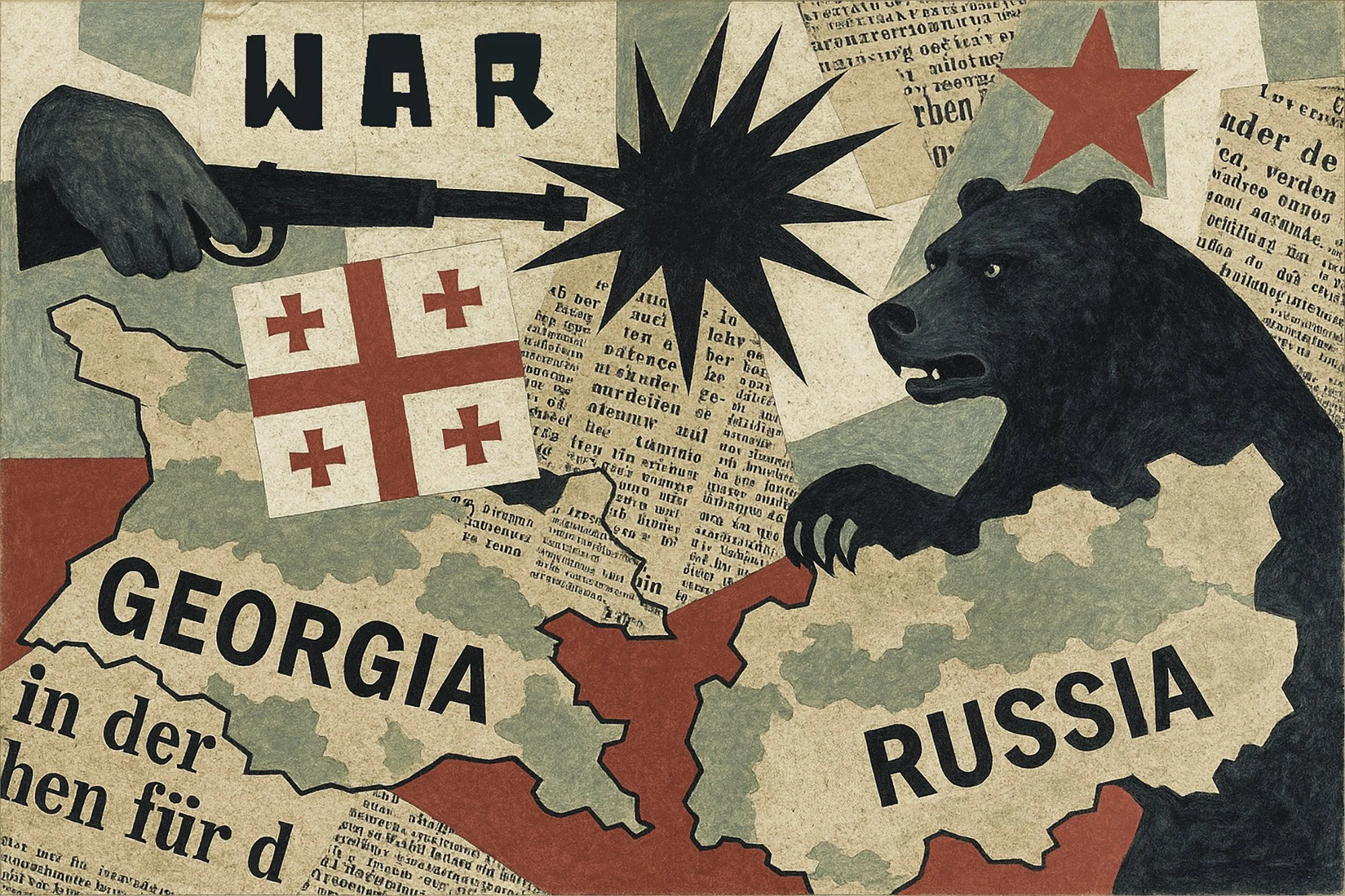
Russia, The Eternal Return of Suppression: From Georgia to Ukraine

The 21st century saw Russia reassert itself on the world stage — often through military force.

War in Georgia
In 2008, tensions in the Caucasus erupted. Georgia sought to reclaim the breakaway regions of South Ossetia and Abkhazia, which were backed by Moscow. Russia responded with a swift military intervention, routing Georgian forces and recognizing the two regions as independent — a signal that Moscow would not tolerate NATO’s eastward reach.

Ukraine’s Turning Point
In late 2013, Ukraine’s president, Viktor Yanukovych, abandoned a planned agreement with the European Union in favor of closer ties to Russia. This sparked mass protests — the Euromaidan movement — in Kyiv. The demonstrations swelled into a revolution, and Yanukovych fled the country in February 2014.

Annexation of Crimea and War in Donbas
Within weeks, Russian troops seized Crimea, citing the need to protect Russian speakers. A hastily organized referendum — unrecognized by most of the world — formalized its annexation. In eastern Ukraine, pro-Russian separatists declared “people’s republics” in Donetsk and Luhansk. Supported by Russian fighters and weapons, they fought the Ukrainian army in a grinding conflict that left thousands dead.

The Frozen Conflict
The Minsk agreements of 2014 and 2015 sought to end the war but failed to resolve the core dispute. For eight years, low-intensity fighting continued, setting the stage for something far larger.

Further Reading:

  • Richard Sakwa – Frontline Ukraine (2015)

  • Anne Applebaum – Red Famine (2017)

  • Timothy Snyder – The Road to Unfreedom (2018)

  • Serhii Plokhy – Lost Kingdom (2017)

Russia, The Eternal Return of Suppression: From Chaos to Putin

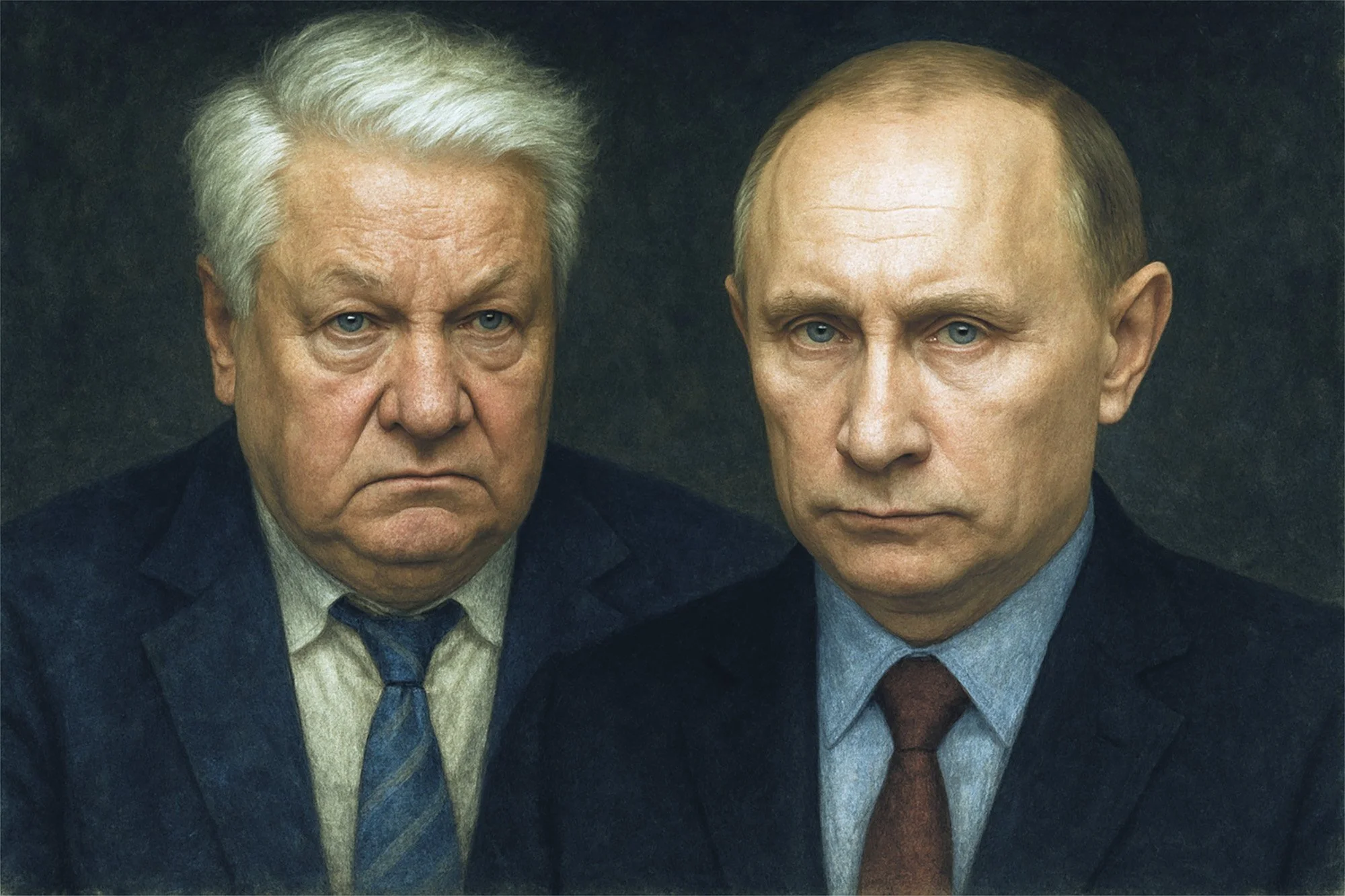
Boris Yeltsin and Vladimir Putin.

The 1990s in Russia were chaotic, hopeful, and brutal all at once. The Soviet collapse brought political freedom, but also economic ruin. Millions saw their savings vanish as inflation soared. State assets were sold off in rigged auctions, creating a new class of billionaires — the oligarchs — while ordinary Russians slid into poverty.

The Yeltsin Years
Boris Yeltsin presided over a turbulent democracy. Parliament clashed with the president; in 1993, tanks shelled the Russian White House during a political crisis. Chechnya declared independence, leading to a bloody war that humiliated the Russian army and deepened public discontent.

The Rise of Putin
In 1999, Yeltsin unexpectedly resigned, naming former KGB officer Vladimir Putin as acting president. Promising order after a decade of chaos, Putin won election in 2000. His early years coincided with a surge in oil prices, fueling economic growth and restoring a sense of stability.

Consolidation of Power
Putin moved quickly to centralize authority. Independent television networks were taken over by the state; regional governors lost their autonomy; political opponents were sidelined or prosecuted. The second war in Chechnya was waged with brutal efficiency, crushing separatism but leaving a legacy of repression.

Further Reading:

  • Anna Politkovskaya – Putin’s Russia (2004)

  • Masha Gessen – The Man Without a Face (2012)

  • Fiona Hill & Clifford Gaddy – Mr. Putin (2013)

  • David E. Hoffman – The Oligarchs (2002)

Russia, The Eternal Return of Suppression: The Fall of the Soviet Union

Mikhael Gorbachev, and his Glasnost and Perestroika.

By the early 1980s, the Soviet Union was a superpower in name but ailing in reality. Its economy was stagnant, its leadership geriatric, and its people weary of shortages and repression. Then came a man who promised change: Mikhail Gorbachev.

Glasnost and Perestroika
Gorbachev, taking power in 1985, sought to reform the system with perestroika (economic restructuring) and glasnost (openness). Censorship was eased; criticism of the government became possible. State enterprises gained more autonomy, and limited private business was allowed. But these reforms also exposed decades of corruption and inefficiency.

Nationalism Resurges
With glasnost came a flood of suppressed history: the Stalinist purges, the secret Molotov–Ribbentrop Pact, and the scale of wartime losses. In the Baltic states, Ukraine, Georgia, and elsewhere, nationalist movements gained momentum. The USSR’s empire in Eastern Europe collapsed almost overnight in 1989, as one communist regime after another fell — first in Poland, then Hungary, East Germany, and beyond.

The Coup and the Collapse
In August 1991, hardline communists staged a coup against Gorbachev. Crowds in Moscow, led by Russian President Boris Yeltsin, resisted, and the coup failed. But the attempt fatally weakened the central government. By December, the leaders of Russia, Ukraine, and Belarus declared the USSR dissolved. On December 25, 1991, the Soviet flag came down over the Kremlin for the last time.

The Legacy
The USSR’s collapse ended the Cold War but left behind 15 independent states, a shattered economy, and unresolved questions about identity and power — questions that still reverberate today.

Further Reading:

  • Serhii Plokhy – The Last Empire (2014)

  • Vladislav Zubok – Collapse (2021)

  • Archie Brown – The Gorbachev Factor (1996)

  • Stephen Kotkin – Armageddon Averted (2001)

Russia, The Eternal Return of Suppression: The Cold War - Confrontation and Control

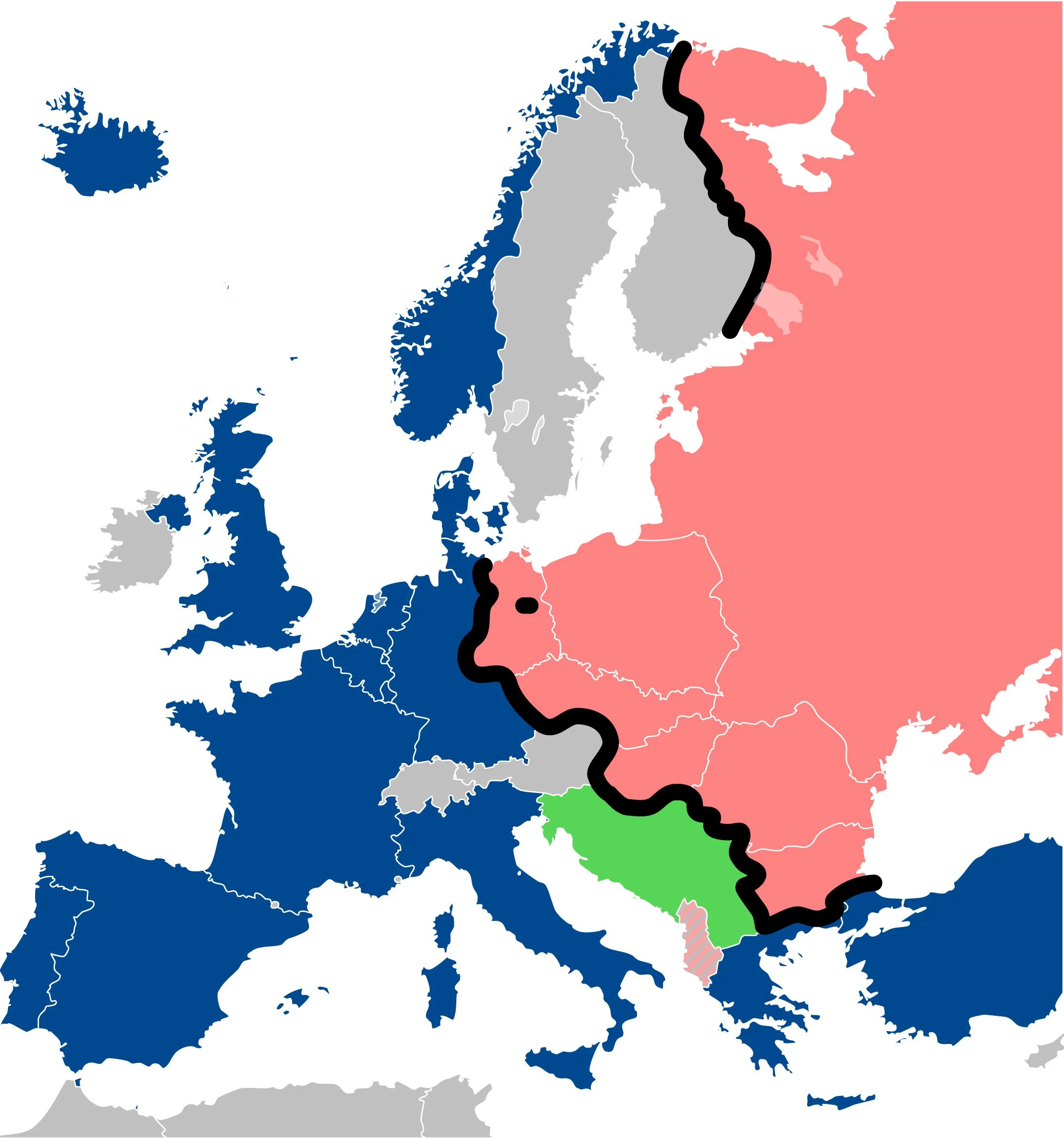
Map of post–World War II Europe illustrating the Iron Curtain dividing Eastern and Western blocs. License: © Sémhur / Wikimedia Commons. Licensed under CC BY‑SA 4.0 (Creative Commons Attribution‑ShareAlike 4.0 International).

The end of the Second World War left Europe divided — and the Soviet Union standing as one of two superpowers. The Red Army’s march west had not only defeated Nazi Germany but also planted the seeds of Soviet influence deep into Eastern Europe. What followed was a forty-year geopolitical standoff that shaped the modern world.

The Iron Curtain Descends
By 1947, Winston Churchill’s “Iron Curtain” speech captured the new reality: Eastern Europe, from the Baltic to the Balkans, was under communist governments loyal to Moscow. The USSR created a buffer zone of satellite states — Poland, East Germany, Czechoslovakia, Hungary, Romania, and Bulgaria — all bound together through political repression, secret police, and a common economic system, COMECON.

Containment and Confrontation
The United States responded with the policy of containment, pledging to halt the spread of communism. NATO was formed in 1949; the Warsaw Pact, its Eastern counterpart, followed in 1955. The Korean War (1950–1953) saw Soviet pilots secretly fighting for North Korea, while crises in Berlin repeatedly brought the superpowers to the brink.

Cracks in the Bloc
Even within the communist camp, unrest boiled. In 1956, a workers’ revolt in Hungary was crushed by Soviet tanks, killing thousands. In 1968, the Prague Spring in Czechoslovakia — a movement for “socialism with a human face” — was similarly put down by a Warsaw Pact invasion. The Brezhnev Doctrine justified such interventions as necessary to preserve the socialist system.

The Arms and Space Races
The Cold War was fought not only with ideology and armies but also with technology. The Soviets shocked the world in 1957 with the launch of Sputnik, the first artificial satellite, and in 1961 by sending Yuri Gagarin into space. But prestige in space masked economic stagnation at home. The nuclear arms race consumed vast resources, and the fear of mutually assured destruction hung over the globe.

Dissent Behind the Curtain
While dissidents like Aleksandr Solzhenitsyn exposed the horrors of the Gulag, and Andrei Sakharov spoke out for human rights, the KGB ensured dissent was contained. Yet underground movements, samizdat literature, and the whispers of reform kept the spirit of resistance alive.

Further Reading:

  • Anne Applebaum – Iron Curtain (2012)

  • John Lewis Gaddis – The Cold War (2005)

  • Vladislav Zubok – A Failed Empire (2007)

  • Tony Judt – Postwar (2005)

Coal, Catholicism, and Community: Henri Poels and the Social Fabric of South Limburg (1900–1930, The Netherlands)

Henri Poels.

When coal was discovered in South Limburg at the turn of the 20th century, it promised jobs, prosperity—and potential trouble. Across Europe, industrial regions had already shown how rapidly growing workforces could become hotbeds of labour unrest, socialism, and political radicalism. In The Hague and in church offices alike, there was quiet concern: how could Limburg’s mining communities grow without becoming a social powder keg?

That challenge found its champion in Monsignor Henri Poels, a priest from Venray who would become known as aalmoezenier van de arbeid—chaplain to the working class. Poels understood that keeping the peace in the mines meant more than sermons on Sunday. It required housing, leisure, and a sense of belonging firmly rooted in Catholic life. His mission was both pastoral and strategic: to “bind the worker to the soil,” as one famous slogan put it, by giving them a stake in stable, faith-based communities.

In 1911, Poels founded Ons Limburg, a cooperative housing association designed to tackle the chronic shortage of decent homes for miners and their families. Good housing, he believed, was a bulwark against the appeal of socialist promises. But bricks and mortar were only the beginning. Poels actively encouraged a dense network of Catholic associations—sports clubs, choirs, youth groups, and mutual aid societies—that would anchor miners’ lives in a shared moral and cultural framework.

His reach extended into the cultural sphere as well. Through initiatives like the NV Tijdig, he supported Catholic-friendly cinema and theatre, offering wholesome entertainment that kept people within the Church’s orbit even in their leisure hours. In the process, he helped shape a “pillar” of Catholic life in Limburg—parallel to, and often in competition with, socialist and liberal networks.

The results were tangible. Catholic miners’ unions provided an alternative to secular labour movements, offering advocacy on wages and conditions without breaking ranks with the Church. Housing cooperatives ensured that miners lived in neighbourhoods designed with parish life in mind—complete with churches, schools, and clubhouses. For decades, this model of faith-led community building kept Limburg’s mining region socially cohesive, even as it absorbed waves of migrant labour from other parts of the Netherlands, Belgium, Germany, and beyond.

By the 1930s, the coalfields of South Limburg were more than an economic engine; they were a laboratory for a uniquely Catholic approach to industrial society. Poels’ legacy still lingers in the brick façades of garden villages, in the archives of miners’ associations, and in the memory of a time when the Church was not only a place of worship, but the architect of an entire way of life.

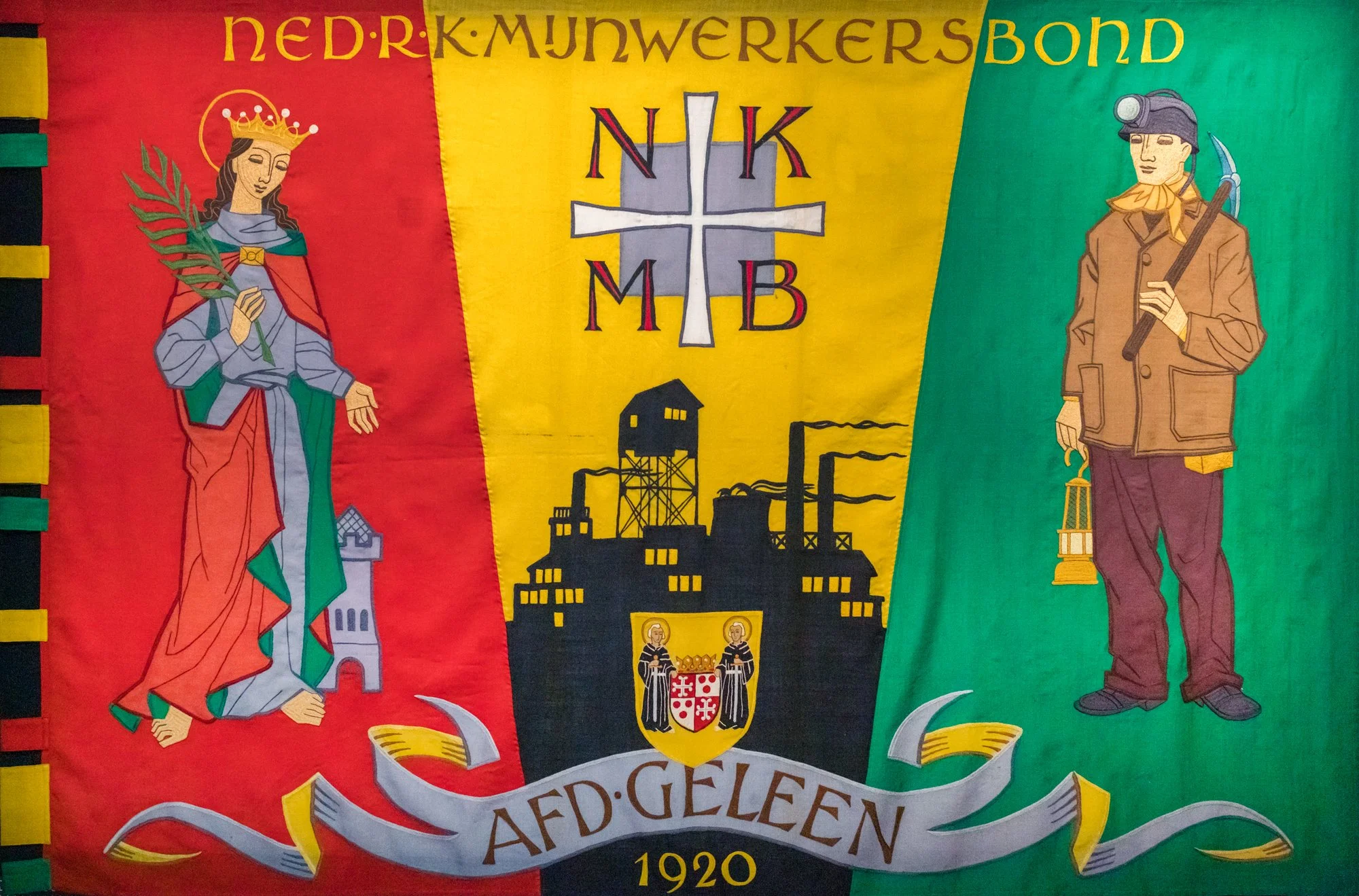
Banner of the Dutch Roman Catholic Miners’ Union, Geleen branch in South Limburg (1920).

Further reading

  • BWSA, Henri Poels (Internationaal Instituut voor Sociale Geschiedenis)

  • Canon van Nederland, Limburg-venster: Ons Limburg and housing policy

  • T. Oort, Film en het moderne leven in Limburg (chapter on associations and cinema)

  • S. Langeweg, Mijnbouw en arbeidsmarkt in Nederlands-Limburg, 1900–1965

  • Katholiek Zuid-Limburg en het fascisme (Maaslandse Monografieën 19)

  • Open Universiteit, “Mijn en Kerk” thematic article

Russia, The Eternal Return of Suppression: The Second World War and a New World Order

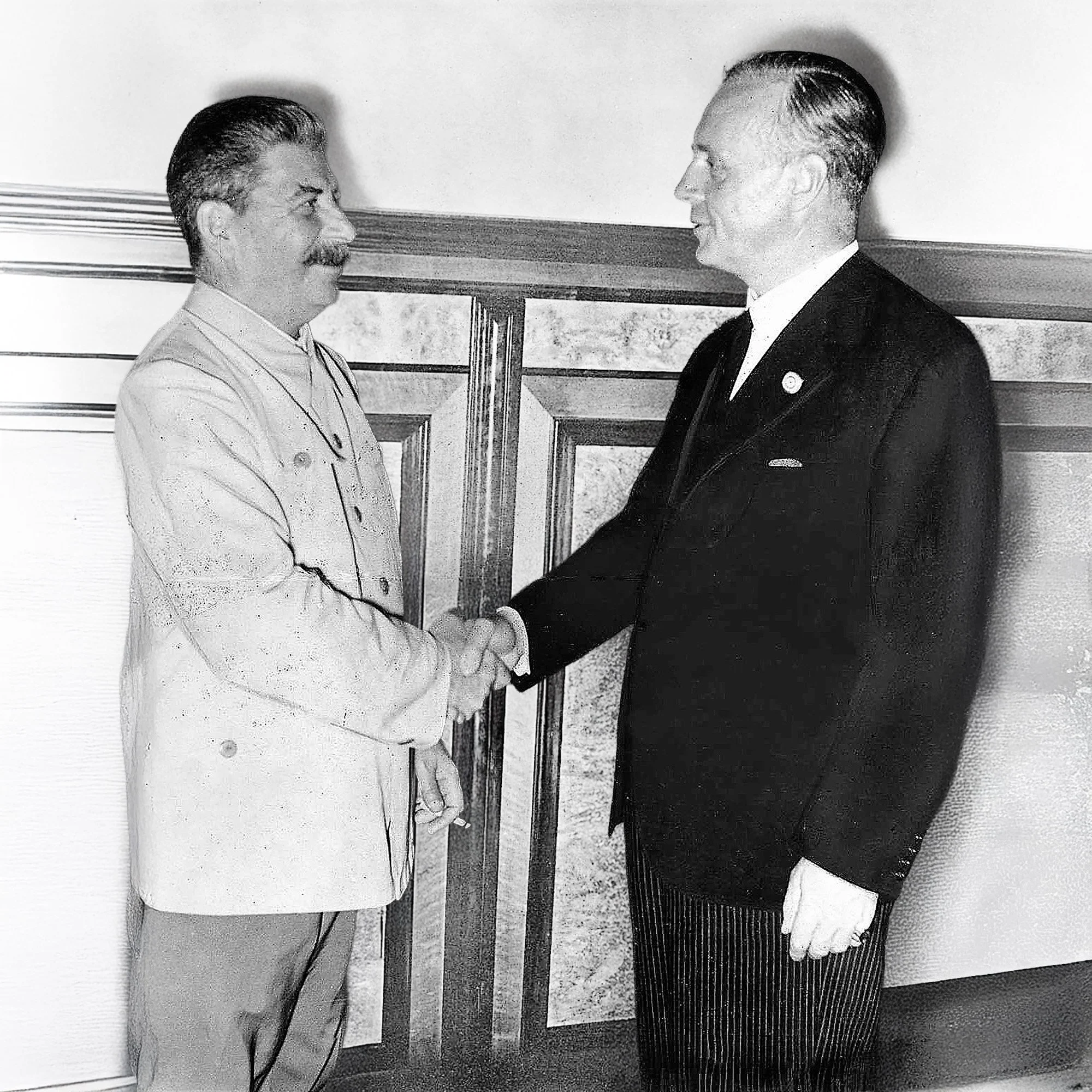
Pact with the Devil, Joseph Stalin shakes hands with German Foreign Minister Joachim von Ribbentrop at the Kremlin, Moscow, 1939. Based on photo: Bundesarchiv, Bild 183-H27337 / CC-BY-SA 3.0 DE.

The Second World War was both a catastrophe and a crucible for the Soviet Union. It transformed the USSR from an embattled revolutionary state into one of the two global superpowers — but at a staggering human cost.

The Pact with the Devil
In August 1939, the world was stunned by the Molotov–Ribbentrop Pact. The Soviet Union, sworn enemy of fascism, signed a non-aggression treaty with Nazi Germany. A secret protocol divided Eastern Europe into spheres of influence. When Germany invaded Poland from the west on September 1, the Red Army marched in from the east two weeks later, seizing territory promised in the pact. Within a year, the USSR had annexed the Baltic states and parts of Romania, and waged a bitter war against Finland in the Winter War of 1939–1940.

Operation Barbarossa: The Shock
At dawn on June 22, 1941, Germany launched Operation Barbarossa, the largest military invasion in history. Three million German soldiers, supported by allies, surged into Soviet territory. Stalin had ignored multiple warnings from Western intelligence and his own spies, convinced Hitler would not break the pact so soon. The result was chaos: Soviet forces were encircled, millions captured, and vast swathes of land overrun in the first months.

A War of Survival
Yet the Soviet Union did not collapse. Moscow did not fall. The Soviet leadership relocated industry east of the Urals, away from German bombers. Ordinary citizens endured unimaginable hardship — cities under siege, villages burned, families torn apart. The Siege of Leningrad lasted 872 days, killing over a million through starvation, shelling, and cold. The Battle of Stalingrad (1942–1943) became the turning point: a brutal, house-to-house struggle that ended with the surrender of an entire German army.

The Road to Berlin
From Stalingrad onward, the Red Army went on the offensive. In 1944, Operation Bagration annihilated Germany’s Army Group Centre, liberating Belarus and pushing west. Soviet troops advanced through Poland, Romania, Hungary, and into the heart of Germany. On May 2, 1945, Berlin fell to Soviet forces, and on May 9, the USSR celebrated Victory Day.

The Human Cost and Political Gain
The Soviet Union emerged victorious, but the toll was staggering: at least 20 million dead, countless wounded, and vast destruction of towns, farms, and infrastructure. Yet geopolitically, the USSR gained enormous influence. Communist governments, backed by Soviet military presence, took power across Eastern Europe. The wartime alliance with Britain and the United States soon gave way to suspicion and rivalry — the Cold War was already germinating.

Further Reading:

  • Richard Overy – Russia’s War (1997)

  • Antony Beevor – Stalingrad (1998)

  • Catherine Merridale – Ivan’s War (2006)

  • Evan Mawdsley – Thunder in the East (2005)

Russia, The Eternal Return of Suppression: From Lenin to Stalin - Building the Soviet State

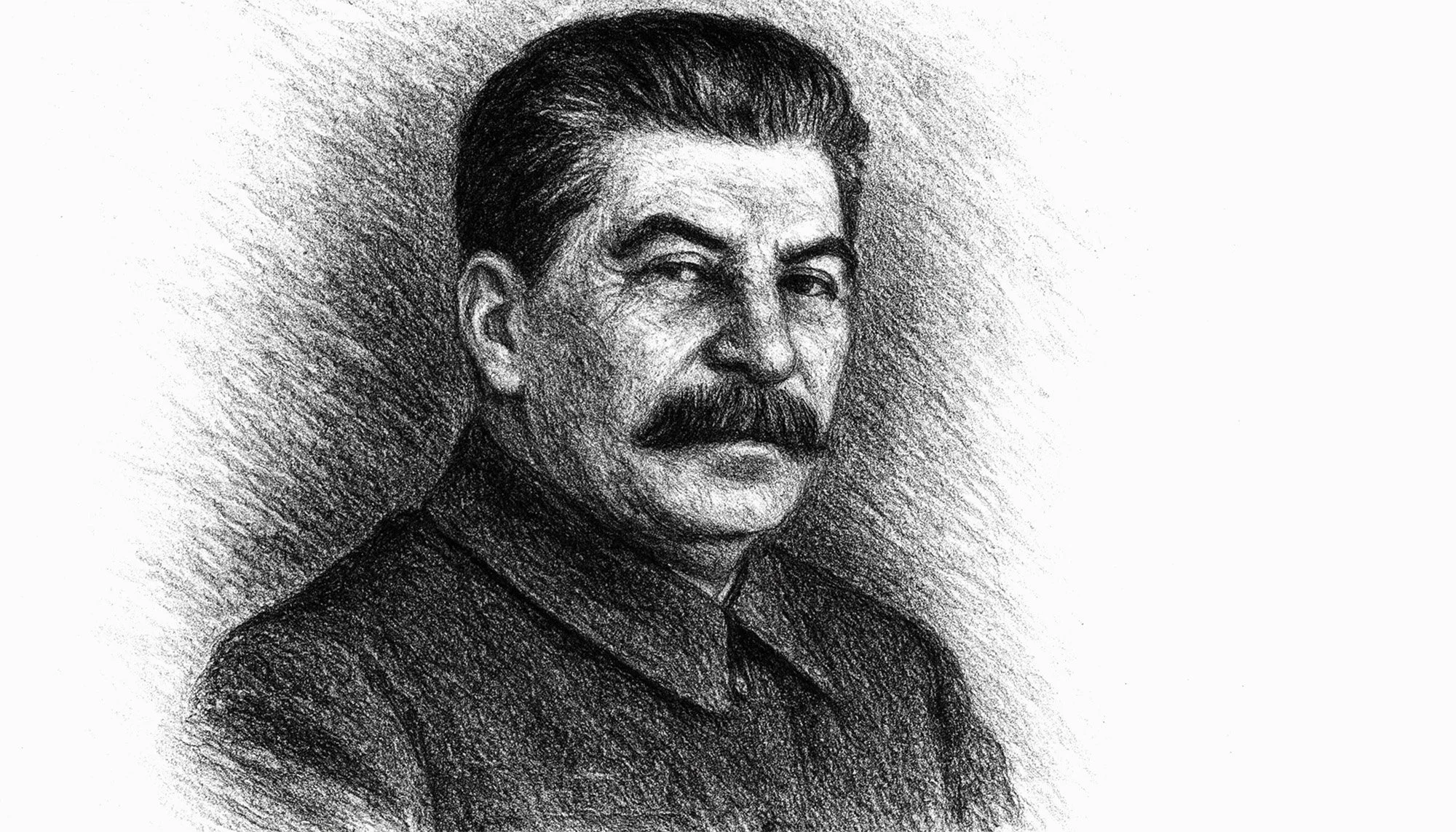
Joseph Stalin

The birth of the Soviet Union in 1922 was both the conclusion of the revolutionary struggle and the beginning of a new experiment in governance. The Bolsheviks had won the Civil War, but they inherited a country ravaged by years of conflict, famine, and economic collapse.

Lenin’s Pragmatic Retreat
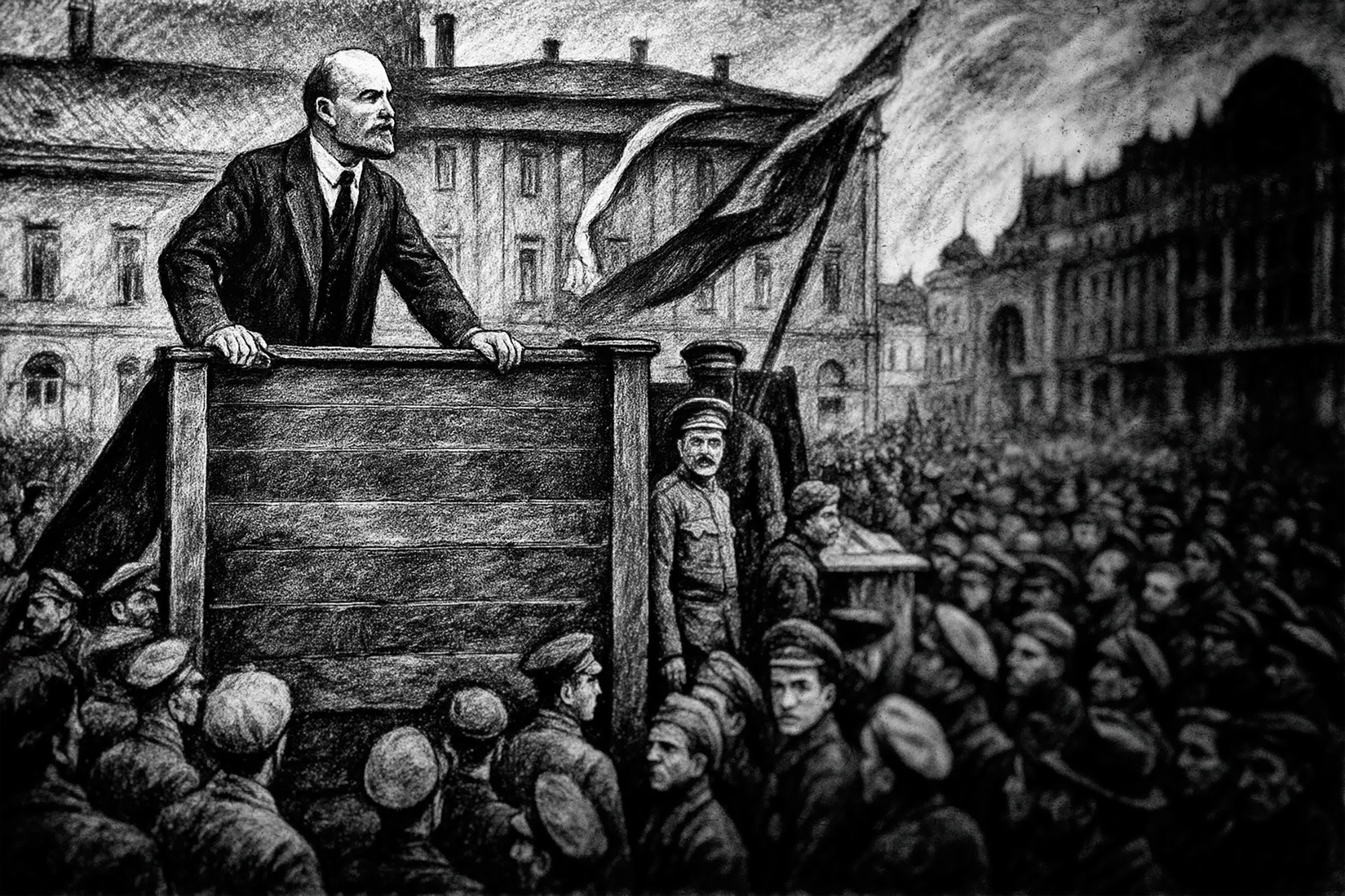
To stabilize the economy, Lenin introduced the New Economic Policy (NEP) in 1921. It was a tactical retreat from full socialism: small businesses and private markets were allowed to operate, peasants could sell surplus grain, and foreign investment was cautiously welcomed. The policy brought modest recovery, but also ideological unease among hardline communists.

The Succession Struggle
When Lenin died in January 1924, he left no clear successor. The ensuing power struggle pitted Leon Trotsky — charismatic leader of the Red Army — against Joseph Stalin, the party’s General Secretary. Stalin used his position to quietly build alliances, control appointments, and marginalize rivals. By the late 1920s, Trotsky was exiled, and Stalin stood unchallenged.

The First Five-Year Plan
In 1928, Stalin launched the First Five-Year Plan, aiming to transform the USSR from an agrarian economy into an industrial superpower. Massive projects such as the Dnieper Hydroelectric Station and the Magnitogorsk steelworks became symbols of progress. Industrial output surged, but at tremendous human cost — workers endured harsh conditions, shortages, and strict discipline.

Collectivization and Famine
In the countryside, Stalin forced millions of peasants into collective farms. Those who resisted — labelled “kulaks” — were deported or executed. Grain was requisitioned to feed cities and finance industrialization, even during poor harvests. The result was famine on a massive scale. In Ukraine, the Holodomor of 1932–1933 killed millions, a trauma that still shapes Ukrainian–Russian relations.

The Great Terror
By the mid-1930s, Stalin’s paranoia turned inward. A wave of purges swept the Communist Party, the military, and the intelligentsia. Show trials extracted confessions through torture; executions and Gulag sentences followed. Entire generations of revolutionary leaders vanished. Yet even as fear spread, the Soviet state consolidated its grip, and Stalin’s image as the “Father of Nations” was cultivated through propaganda.

The Soviet Union on the Eve of War
By the end of the 1930s, the USSR was a formidable industrial power with a centralized command economy. The human toll had been immense, but Stalin believed the sacrifices had prepared the country for the challenges ahead — challenges that would arrive sooner than anyone expected.

Further Reading:

  • Stephen Kotkin – Stalin: Paradoxes of Power (2014)

  • Robert Service – Stalin: A Biography (2004)

  • Orlando Figes – Revolutionary Russia 1891–1991 (2014)

  • Sheila Fitzpatrick – Everyday Stalinism (1999)

Russia, The Eternal Return of Suppression: 1917 - Two Revolutions and a Civil War

The year 1917 was a whirlwind that shattered centuries of monarchy and reshaped the map of Eurasia. It began with bread queues and strikes, and ended with the birth of the world’s first socialist state.

February: The Fall of the Tsar
By February, Petrograd was gripped by strikes and food riots. Soldiers refused orders to fire on crowds and joined the demonstrators instead. Within days, the centuries-old Romanov dynasty collapsed. Nicholas II abdicated, and a Provisional Government took over, promising liberal reforms and elections.

Dual Power and Disillusionment
The Provisional Government shared power uneasily with the Petrograd Soviet, a council of workers’ and soldiers’ deputies. The government kept Russia in World War I, hoping to honor alliances with Britain and France. This decision proved disastrous, as the war continued to drain resources and lives. Radical parties gained support, especially the Bolsheviks, who called for “Peace, Land, Bread.”

October: The Bolshevik Takeover
Led by Lenin, the Bolsheviks staged an armed uprising on October 25 (November 7 in the modern calendar). They seized key points in Petrograd and toppled the Provisional Government almost without bloodshed. The new Soviet regime withdrew from the war through the harsh Treaty of Brest-Litovsk, ceding large territories to Germany.

Civil War and Red Victory
From 1918 to 1922, Russia descended into civil war. The Bolshevik Red Army fought the White forces — a mix of monarchists, republicans, and foreign intervention troops — across a vast front. Nationalist movements sought independence in Ukraine, the Baltics, and the Caucasus. The Reds ultimately triumphed, consolidating control through the Cheka secret police and “War Communism,” which requisitioned grain and suppressed dissent. In 1922, the Union of Soviet Socialist Republics (USSR) was officially proclaimed.

Further Reading:

  • John Reed – Ten Days That Shook the World (1919)

  • Sheila Fitzpatrick – The Russian Revolution (1982)

  • Richard Pipes – The Russian Revolution (1990)

  • A. Beevor – Russia: Revolution and Civil War 1917-1921 (2022)

Ferdinand III: The Warrior King and Saint Who United a Kingdom

King Ferdinand III of Castile and León.

In the pages of Spanish history, few figures shine as brightly—or as devoutly—as Ferdinand III of Castile and León. Born in 1199 and reigning from 1217 until his death in 1252, Ferdinand was not only a formidable warrior king but also a deeply religious man who would later be canonized as Saint Ferdinand. His life, caught between crusade and court, devotion and diplomacy, helped shape the future of a unified Spain.

From Child of War to King of Two Crowns

Ferdinand was born into conflict. His mother, Berengaria of Castile, and his father, Alfonso IX of León, had a marriage annulled by the pope—yet Ferdinand would inherit both their thrones. When his father died in 1230, Ferdinand deftly negotiated with his half-sisters to inherit León, thus uniting it with Castile. For the first time in generations, these rival kingdoms were under a single crown, laying the groundwork for the modern Spanish state.

But Ferdinand didn’t stop at diplomacy.

The Christian Reconquest Gains Ground

With fire in his heart and a sword in his hand, Ferdinand turned south. It was the time of the Reconquista, the centuries-long Christian campaign to reclaim the Iberian Peninsula from Muslim rule. Ferdinand became its most determined general. Under his leadership, great cities fell back into Christian hands: Córdoba (1236), the intellectual jewel of Al-Andalus; Jaén (1246), gateway to the south; and finally, Seville (1248), a glittering cosmopolitan city on the Guadalquivir River.

His conquests were not wanton. Ferdinand was known for his chivalry and tolerance—often allowing defeated Muslim populations to remain in their cities under protection, a remarkable policy for the time.

A Builder of Cathedrals and a Saint of the People

Beyond the battlefield, Ferdinand was a patron of architecture and education. He began the construction of the great Gothic Cathedral of Burgos, supported religious foundations, and strengthened the University of Salamanca. He was beloved for his justice and humility, often settling disputes himself and walking barefoot to churches in penance.

He died in Seville in 1252, dressed not in royal finery but in the humble habit of a Franciscan monk. A century later, in 1671, Pope Clement X made his sainthood official. Today, he lies in a silver shrine in the Cathedral of Seville, still clad in monk’s robes, still revered as a unifier of kingdoms and a saint of swords and mercy.

In a time when kings were often tyrants or figureheads, Ferdinand stood out: a king who could conquer cities and hearts alike. His blend of martial prowess, political savvy, and deep Christian faith helped not just shape a kingdom—but also set a moral tone that inspired centuries of Castilian identity.

Saint Ferdinand isn't just a figure from dusty chronicles. He’s a reminder that power and piety, ambition and humility, can coexist—and even transform a nation.

Further Reading

  • O'Callaghan, Joseph F. The Learned King: The Reign of Alfonso X of Castile, for background on Ferdinand’s son and legacy.

  • Barton, Simon. A History of Spain, for context on the Reconquista.

  • The Cathedral of Seville official site, which still honors Ferdinand III with processions each May 30.

Bertrand du Guesclin’s Spanish Adventure

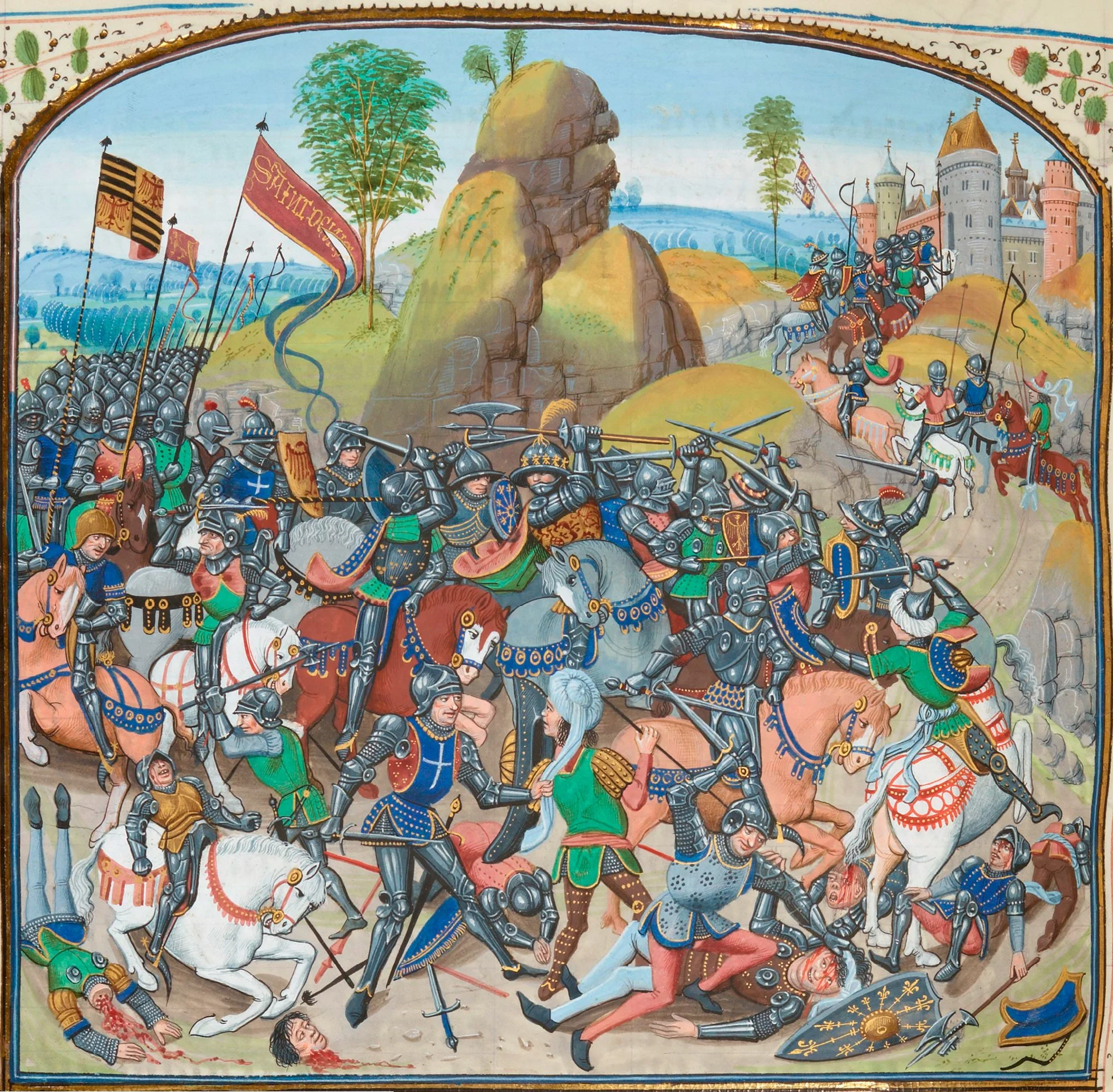
The Battle of Montiel (1369) was the final clash in Castile’s civil war, where Enrique of Trastámara defeated and killed his half-brother, Pedro the Cruel, ending a brutal dynastic conflict. (Miniature from Jean Froissart's "Chronicles".)

The road was dry, the wind harsh. Dust curled around the hooves of tired horses. Among the mercenaries and exiled lords rode a dark figure in battered armor, his face shaded by a heavy helmet, his eyes sharp and unreadable. He wasn’t tall or handsome, and he wasn’t born to rule. But Bertrand du Guesclin (~1320-1380), son of a minor Breton knight, was about to change the fate of a kingdom that wasn’t his.

This wasn’t France. This was Castile. And this wasn’t his war. But it would become his story.

A Kingdom Torn in Two

Castile in the 1360s was a land of ambition and betrayal. Two brothers claimed the throne.

The first, Pedro I, ruled from Toledo with an iron fist. His enemies called him Pedro the Cruel, and they had reason to. Rebellions were crushed. Rivals vanished. Allies were disposable. But Pedro had powerful friends abroad—especially the Black Prince, the heir to the English crown and commander of elite troops.

The second, Enrique of Trastámara, was his half-brother, born outside of marriage. He had no lawful claim to the throne, but plenty of noble supporters—and the backing of the French king. Enrique fled north to seek help. And France answered, not with armies, but with one man who could lead them all.

They sent du Guesclin.

The Breton and the Pretender

Bertrand du Guesclin was not a man of polish. People said he looked like a bear and fought like one too. He didn’t win battles with speeches or splendor—he won them with cunning and grit. He had clawed his way up through the ranks of France’s endless war with England, earning a fearsome reputation and a name: The Black Dog of Brocéliande.

In 1366, du Guesclin led a motley army across the Pyrenees. Mercenaries, outlaws, knights of fortune—they followed him not for glory, but because he got results.

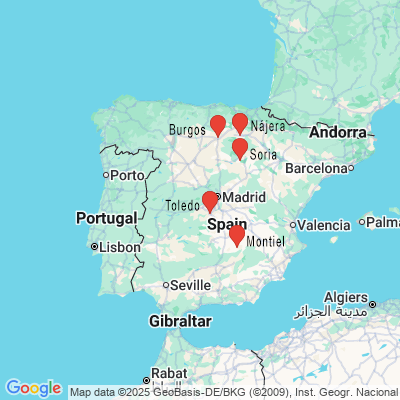
The campaign began well. Soria, Burgos, and Toledo all opened their gates to Enrique. Pedro fled. For a moment, the road to power seemed open.

But the English weren’t far behind.

Disaster at Nájera

In 1367, the armies met near the town of Nájera. The Castilian sun beat down on the banners of France and England, as du Guesclin faced off against the Black Prince himself.

It was a slaughter.

Du Guesclin was captured. Enrique ran. Pedro, cruel as ever, returned to his throne.

But Pedro didn’t win the war. He lost the people. While Enrique rebuilt, Pedro grew more isolated, more hated. And du Guesclin? He was ransomed—and returned.

He always returned.

The End at Montiel

The final act played out two years later, in 1369, at the fortress of Montiel, where Pedro’s army, weary and thin, was surrounded. Du Guesclin led the siege.

One night, Pedro slipped from the castle, trying to escape. But he was caught and brought to Enrique’s tent.

What happened next has passed into legend.

Some say Enrique hesitated. Brother or not, this was murder. Others say he moved without blinking. Du Guesclin, watching the drama unfold, supposedly said:
"I do not kill kings… but I open the door."

And he did.

Pedro was dead. Enrique was king. And Castile, now ruled by a French ally, would never again stand with England.

Echoes on the Wind

Bertrand du Guesclin returned to France, where he rose even higher—commander of the French armies, hero of the reconquest. But Spain stayed with him, a strange land where he’d helped make a king.

If you walk today through Toledo’s stone streets, or climb to the ruined fortress at Montiel, or stand in the plaza of Burgos, listen. You might hear the low rumble of horses, the rasp of old armor, the voice of a knight who wasn’t meant to rule—but ruled the moment all the same.

Further Reading

  • Bertrand du Guesclin by Georges Minois

  • The Hundred Years War, Vol. II: Trial by Fire by Jonathan Sumption

  • The Black Prince by Michael Jones

  • La vie et les faits mémorables du très vaillant chevalier Bertrand du Guesclin by Cuvelier (14th century epic poem)

  • Local historical exhibits in Toledo, Montiel, and Burgos cathedrals

Russia, The Eternal Return of Suppression: The Fuse to the Powder Keg - Russia Before 1917

Tsar Nicholas II

In the early 20th century, the Russian Empire was vast, diverse, and unstable — a giant straddling Europe and Asia, rich in resources yet poor in governance. Tsar Nicholas II sat atop an autocratic system that resisted meaningful reform, even as the world around it modernized. The gap between the ruling elite and the majority of the population was staggering.

A Land of Peasants and Aristocrats
Over 80% of Russians were peasants, living in rural villages bound by centuries-old traditions. Many still carried the memory of serfdom, abolished only in 1861, and freedom had brought little improvement. Small plots, heavy taxes, and outdated farming methods left millions in chronic poverty. Meanwhile, a tiny aristocracy — less than 2% of the population — owned vast estates and enjoyed lives of comfort and privilege.

Industrialization Without Inclusion
By the late 1800s, Russia was industrializing, but unevenly. St. Petersburg and Moscow had textile mills, metal works, and railways. Harsh factory conditions, long hours, and low pay bred resentment among workers. The new urban proletariat had no political voice; trade unions were illegal, strikes often met with armed force. Russia’s economic modernization created the very class that would later become the backbone of revolutionary movements.

The Empire of Many Nations
Russia was not a homogeneous state. It ruled over Poles, Ukrainians, Balts, Finns, Armenians, Georgians, and Central Asian peoples — many of whom resented Russian dominance. Nationalist movements grew in strength, often clashing with the imperial government, which sought to “Russify” minorities by imposing the Russian language and Orthodox religion.

1905: The First Shockwave
The Russo-Japanese War (1904–1905) was meant to project imperial power but ended in humiliation. The defeat sparked unrest at home, culminating in the events of January 9, 1905 — “Bloody Sunday” — when troops fired on peaceful demonstrators in St. Petersburg. Nationwide strikes, mutinies, and uprisings followed. The tsar reluctantly granted a parliament, the Duma, but its powers were limited, and opposition parties were repressed. The monarchy had dodged collapse, but its legitimacy was badly weakened.

World War I: The Breaking Point
When war broke out in 1914, patriotism ran high, but Russia’s military was poorly equipped and badly led. Casualties mounted into the millions. The home front suffered from food shortages, inflation, and collapsing transport networks. By 1916, the tsar’s decision to take personal command of the army tied him directly to its failures. Meanwhile, political intrigue in the capital, symbolized by the influence of the mystic Rasputin, discredited the monarchy further. The empire was a powder keg — and the spark was coming.

Further Reading:

  • Orlando Figes – A People’s Tragedy (1996)

  • Hugh Seton-Watson – The Russian Empire 1801–1917 (1967)

  • S. A. Smith – Russia in Revolution (2017)

The Black Death in Europe

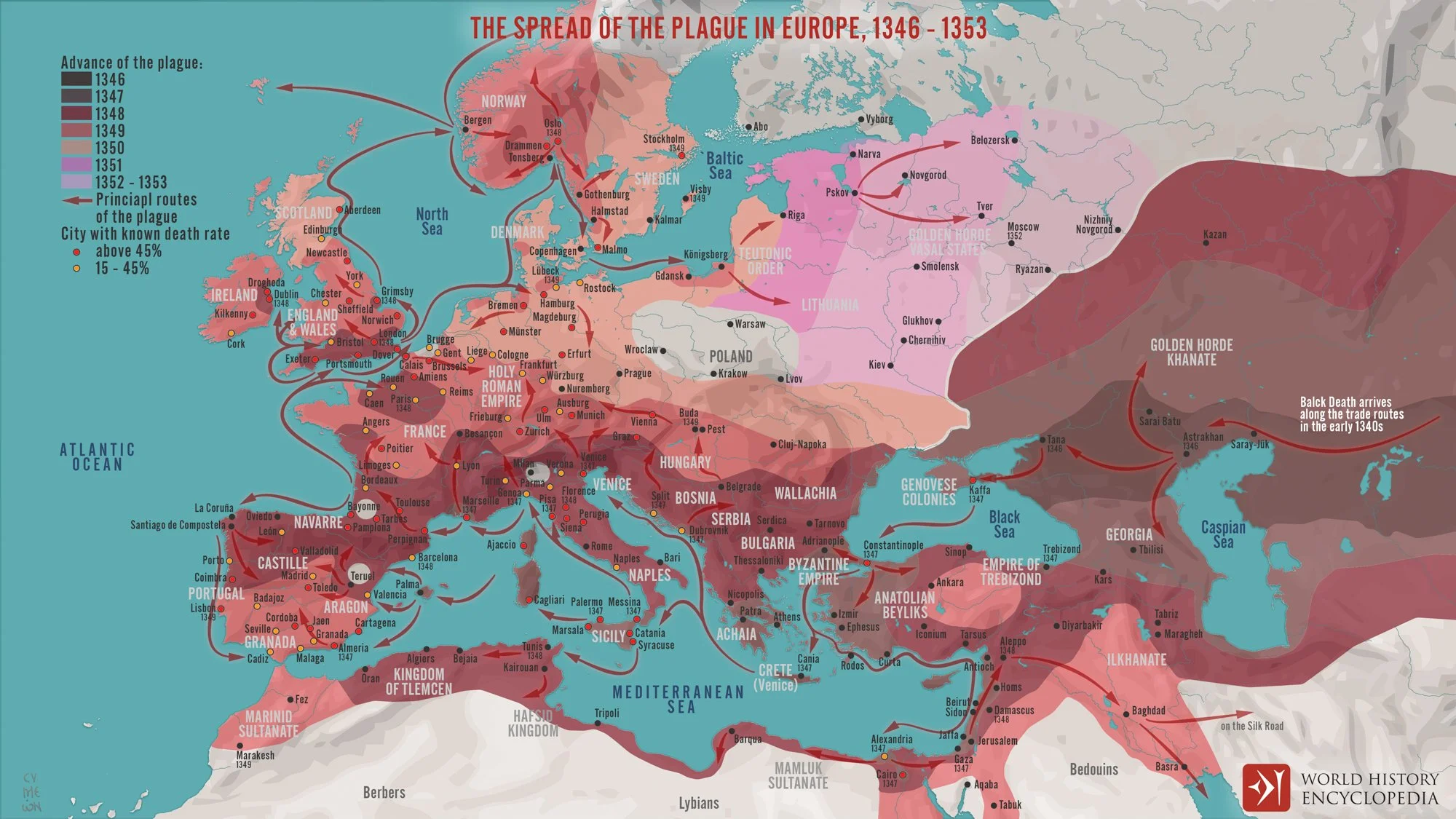
The Spread of the Plague in Europe, 1346–1353" by Simeon Netchev. © World History Encyclopedia. Licensed under CC BY-NC-SA 4.0. Available at: https://worldhistory.org/image/12038/the-spread-of-the-plague-in-europe-1346---1353.

Plagues were not new to Europe. Outbreaks had come and gone for centuries, often leaving sorrow in their wake. But in the late 1340s, something changed. A new wave of plague struck Europe with a force no one had seen before—or since.

It began in 1347, when trading ships arrived in the Sicilian port of Messina. Onboard were dead or dying sailors—and rats carrying fleas infected with Yersinia pestis. Within months, the disease spread across the Mediterranean and deep into the heart of Europe. This time, it didn’t just take lives—it shattered an entire world.

A Pandemic Unleashed

Between 1347 and 1353, the plague tore across the continent in wave after wave. Within six short years, it claimed the lives of an estimated 25 to 50 million people—between 30% and 60% of Europe’s population.

Though plague outbreaks would return regularly in later centuries, this first explosion was by far the most deadly. No region was untouched, but some places suffered extraordinarily high mortality rates:

Cities hit especially hard:

  • Florence: ~60% mortality (~60,000 deaths out of ~100,000 inhabitants)

  • Paris: ~50% mortality (~100,000 deaths out of ~200,000 inhabitants)

  • London: ~45% mortality (~40,000 deaths out of ~90,000 inhabitants)

  • Venice: ~60% mortality (~60,000 deaths out of ~100,000 inhabitants)

  • Avignon: ~55% mortality (~11,000 deaths out of ~20,000 inhabitants, recorded in just a few weeks)

  • Barcelona: ~40% mortality (~16,000 deaths out of ~40,000 inhabitants)

By 1351, the plague reached Poland and parts of Russia. In many towns, entire neighborhoods were abandoned. Fields went untilled, shops closed, and churches fell silent. The dead were buried in mass graves, sometimes without rites or names.

Death and Transformation

The Black Death brought chaos—but also change. With fewer workers, wages rose. The old feudal order began to erode. Many questioned the authority of the Church, especially as priests and bishops died alongside commoners.

Fear led to violence. In parts of Europe, Jewish communities were scapegoated, accused of poisoning wells, and brutally massacred. Elsewhere, people turned to religion, mysticism, or radical movements like the flagellants.

Yet from the ruins, something new slowly emerged: a deeper awareness of human fragility—and a spark of cultural transformation that would later blossom into the Renaissance.

A Timeless Warning

Art from the time, like the famous Danse Macabre, shows death leading kings, cardinals, and beggars hand in hand. The message was clear: no one escapes the dance.

The Dance of Death: The Cardinal and the King
This woodcut depicts two powerful figures—a cardinal and a king—being led away by personifications of Death. It is part of the Danse Macabre tradition, a late medieval allegory that reminds viewers of the inevitability of death, regardless of rank or status. The image originates from the 1490 edition of La Danse Macabre printed by Guyot Marchant in Paris, one of the earliest and most influential printed versions of this theme.

Centuries later, this moment still haunts us—not just for its suffering, but for how it changed the world.